Eye Floaters – In Brief
- The most common cause is vitreous floaters – harmless shadows of small opacities inside the eye that appear with age, more frequently in myopic individuals.
- Warning: a sudden ‘shower’ of new floaters, flashes of light, or a shadow in your field of vision may indicate a retinal tear or detachment – examination on the same day.
- Eye stroke (retinal vessel occlusion) causes sudden, painless vision loss in one eye – this is an emergency.
- Diagnosis: fundus examination after pupil dilation and retinal OCT – at SwissLaser in Warsaw and Krakow.
Have you ever found yourself chasing a small, dark spot with your eyes, only for it to dart away as soon as you tried to look at it? Or perhaps, looking at a bright sky, you see delicate threads, as if someone had scattered a spiderweb before you? Don’t worry, you haven’t gone mad. Eye floaters are a phenomenon that affects up to 70% of us after the age of 50. Usually, it’s just an innocent sign that our eyes are aging. But beware – the line between physiology and serious illness can be very thin. At SwissLaser in Warsaw and Krakow, we know that any change in vision can be frightening. That’s why we’ve prepared this guide. Read on to know when you can sleep soundly and when you should rush to the doctor.
What will you learn from the text below?
- What are these annoying ‘flying gnats’? These are usually shadows cast by the shrinking interior of the eye (vitreous body) – in 90% of cases, they are harmless.
- When should floaters concern you? If you suddenly see a whole swarm of them, accompanied by flashes (like a camera flash), it could indicate a retinal tear.
- Can you have an eye stroke? Unfortunately, yes – sudden, painless vision loss is often a vessel blockage that requires action within 4-6 hours.
- How does SwissLaser deal with vision disturbances? We have a whole arsenal: from lasers and modern lenses to advanced injections and microsurgery.
- How to take care of your eyesight yourself? Simple habits are enough, like a diet rich in antioxidants and the 20-20-20 rule when using a computer.
Floaters, Threads, and ‘Flying Gnats’ – What Are You Really Seeing?
Patients often tell us: “Doctor, I see as if through a dirty window” or “Something is floating in front of my eye.” Sometimes it’s dots, sometimes ‘worms’ or clumps of wool. Although you’d swear these objects are flying in front of your face, they are actually inside. These are shadows cast onto the retina by tiny debris floating within the eyeball.
How to distinguish harmless symptoms from warning signs?
That’s the million-dollar question. If your ‘gnats’ have been with you for years and merely drift lazily in your field of vision, there’s usually no cause for panic.
When does a red light flash? When the situation changes dynamically. If suddenly, in one evening, you see a ‘shower’ of soot, accompanied by flashes of light (photopsia), or you feel like someone is drawing a black curtain over your eye – don’t wait until Monday. This is a vision-threatening emergency.
What are vitreous floaters and why does (almost) everyone have them?
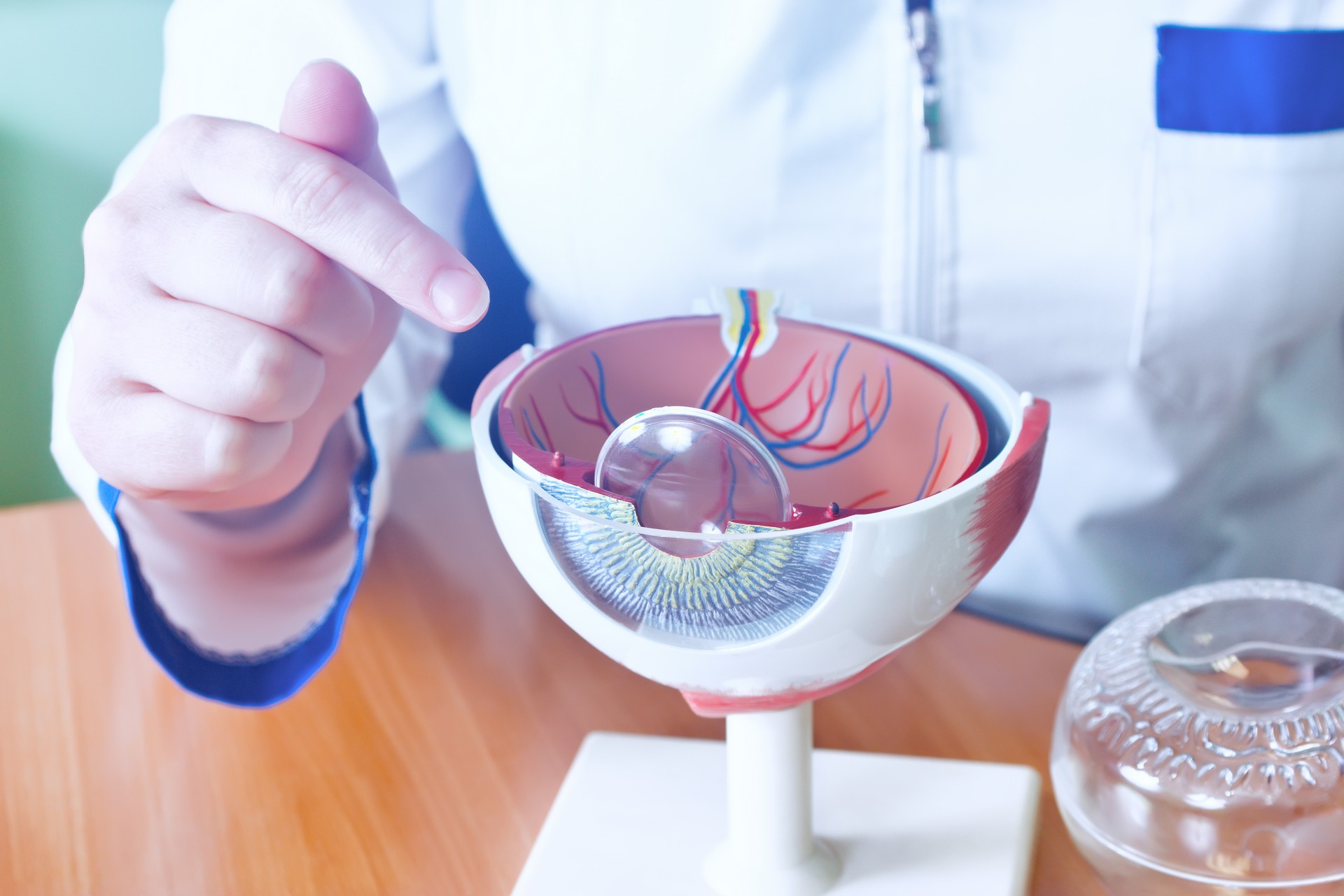
Imagine your eye is filled with jelly – that’s the vitreous body. When you’re young, this jelly is perfectly transparent and elastic. But with age, like any gel, it begins to shrink and break into pieces. Collagen fibers clump together, and it’s these microscopic clumps that you see as ‘flying gnats.’ It’s a bit like tea leaves in your tea – annoying, but usually harmless.
Most Common Causes of Vision Disturbances – When is Lubrication Enough?
No, not every spot before your eye means surgery. Sometimes the cause is prosaic and literally on the surface.
Dry Eye Syndrome: when fog before the eyes results from a lack of tears
Did you know that even one in three people over fifty has Dry Eye Syndrome? When the eye dries out, its surface becomes rough like parched earth. Light, instead of entering directly, refracts chaotically.
- What do you feel? Grittiness under your eyelids, burning, and periodic blurring that miraculously disappears when you blink harder.
- What to do? Often, good quality preservative-free eye drops and a break from screens are enough.
Cataracts: why does the world lose contrast and color?
Cataracts are nothing more than the clouding of your natural lens. This doesn’t happen overnight – it’s a process that takes years.
- What does it look like? Colors fade (as if you’re looking through an old Instagram filter), the image is dull, and car lights at night start to blind you.
- Solution: Cataract treatment is standard today. At SwissLaser, we replace the clouded lens with a new, artificial one (e.g., premium) in a matter of minutes. The result? Often better vision than in your youth.
Red Flag: When Floaters Signal Retinal Diseases?
Here, the jokes end. The retina is the ‘matrix’ of your eye. If it breaks down, the image disappears permanently.
Retinal Tear and Detachment – why time matters (24-72h)?
Remember that shrinking ‘jelly’ in your eye? Sometimes it pulls the retina so hard that it creates a hole. Then fluid gets underneath and starts to peel it off, like wallpaper from a wall.
- Symptoms: Sudden onset of floaters + flashes in the corner of the eye + a ‘black curtain’ obscuring vision.
- Your reaction: You have 24 to 72 hours for rescue. Prompt surgery offers a 90% chance of success. Waiting a week? The chances plummet.
Diabetic Retinopathy and AMD – how to protect central vision?
Diabetes works insidiously – it destroys tiny vessels, causing hemorrhages (which you see as dark spots). AMD (Age-related Macular Degeneration), in turn, steals what is most important – the ability to read and recognize faces, leaving a dark spot in the very center of the field of vision.
Eye Stroke – A Sudden Condition Requiring Immediate Action
Every child knows about heart attacks. Few know about eye strokes, although the mechanism is strikingly similar.
Painless vision loss: how to recognize vessel occlusion?
An eye stroke is simply a blockage in the retinal artery or vein. The most terrifying thing is that it doesn’t hurt.
You might be eating breakfast and suddenly stop seeing with one eye. Or the image might become drastically blurred within minutes.
The golden hour: why treatment must be implemented immediately?
In this case, time literally means vision.
Dr. Victor Derhartunian warns:
“We have a so-called therapeutic window – it’s only 4 to 6 hours. Retinal cells without oxygen suffocate and die rapidly. If you come to us within this time, we have up to an 80% chance of saving your vision. After 24 hours? The chances are close to zero. If you suddenly lose your sight – do not go to sleep hoping that ‘it will pass by morning.’ Go to the emergency room.”
Diagnostics at SwissLaser – How We Find the Source of the Problem?
In our clinics, we don’t guess. We have technology that allows us to look into every corner of the eye.
OCT and Fundus Examination – A Precise Look Deep Inside the Eyeball
- Fundus examination: The doctor looks through the pupil like through a keyhole, searching for holes, hemorrhages, or diabetic changes.
- OCT (Tomography): This is a bit like an ultrasound, but done with a beam of light. It shows us a cross-section of the retina with micrometer accuracy. We see things there that are invisible to the naked eye.
Angiography and Ocular Ultrasound – Advanced Methods for Detecting Changes
When we suspect vascular problems (e.g., with diabetes), we perform angiography with contrast. And if the cataract is so dense that nothing can be seen through it? Then ultrasound comes into play, allowing us to assess what is happening at the back of the eye.
Modern Treatment Methods – How to Regain Clear Vision?
Diagnosis is just the beginning. Depending on what we find, we have a ready action plan.
Vitrectomy and Laser Therapy: can floaters be surgically removed?
Your brain will learn to ignore most floaters. But if they are so large that they obscure your vision, we can perform a vitrectomy – that is, remove and replace the fluid inside the eye. For retinal tears, we use a laser that ‘welds’ it into place before it detaches.
Anti-VEGF Injections and Lasers in Retinal Disease Therapy
For AMD or diabetic retinopathy, we administer medications directly into the eye (injections). Sounds like a horror movie? Don’t worry, it’s almost painless and can stop the disease and save central vision in 90% of patients.
Cataract Surgery with Premium Lens Implantation
This is the most frequently performed procedure worldwide. We remove the old lens, insert a new one, and… done. At SwissLaser, we use lenses that can also correct your refractive error (myopia, astigmatism, and even presbyopia).
Daily Prevention – How to Care for Your Eyes to See Clearly?
You can’t control everything (you can’t cheat genetics), but you can help your luck.
Eye Diet: the role of antioxidants and Omega-3 fatty acids
Feed your eyes! They love lutein (spinach, kale) and Omega-3 fatty acids (fatty fish). They act as an internal filter and ‘lubricant,’ protecting the retina from aging.
Workplace Hygiene and the 20-20-20 Rule in the Digital Age
Sitting in Excel? Do your eyes a favor: every 20 minutes, look at something 20 feet (approx. 6 meters) away for 20 seconds. This is free relaxation for your eye muscles that really works.
FAQ – Frequently asked questions
Can floaters disappear on their own?
Those from small hemorrhages can be absorbed. Typical vitreous floaters usually remain, but the brain learns to ‘filter them out’ of the image (neuroadaptation) and you stop noticing them. Sometimes they simply settle at the bottom of the eye, disappearing from your field of vision.
Does an eye stroke hurt?
That’s precisely the problem – usually not. An eye stroke is a sudden, but painless darkness. Pain rarely occurs, e.g., if it’s accompanied by an acute glaucoma attack.
Can I drive with floaters?
Single ‘specks’ usually don’t interfere. But if you have large clusters that suddenly obscure your vision, or you see flashes – skip driving and call an ophthalmologist.
How often should I have my eyes checked after fifty?
Once a year is the absolute minimum. Get a full check-up with a fundus examination, even if you think you see perfectly. Glaucoma or AMD are ‘silent vision thieves’ – they steal it imperceptibly at first.
How to get rid of eye floaters?
Ordinary floaters are not removed with drops or supplements – there is no medicine that dissolves them. Over time, the brain learns to ignore them. For large, persistent floaters, laser vitreolysis (YAG) or vitrectomy may be considered, but only in selected cases and after a thorough retinal evaluation.
Are eye floaters dangerous?
The floaters themselves usually aren’t. What sometimes accompanies them can be dangerous: a sudden shower of new floaters, flashes of light, and a shadow in the field of vision can indicate a retinal tear or detachment. In such cases, time is critical – a fundus examination should take place on the same day.
Are eye floaters during pregnancy normal?
Single, previously known floaters – yes. New floaters with a headache, swelling, or elevated blood pressure during pregnancy require urgent consultation, as they may be a symptom of pre-eclampsia. It is worth mentioning them to your obstetrician.
Does stress cause eye floaters?
Stress and fatigue do not create vitreous floaters, but they make us notice them more often. Short-term ‘floaters’ also appear with a drop in blood pressure or migraine with aura. If the symptom persists or recurs, an ophthalmological examination will determine the cause.
When to report for an examination
Vitreous opacities and floaters can be harmless, but their sudden appearance requires a retinal check.
- Fundus examination — assessment of the retina and vitreous body
- OCT examination — imaging of retinal layers
- Ophthalmologist in Krakow — eligibility assessment and comprehensive diagnostics
- Diagnostic tests – price list