Dry Eye Syndrome in Brief
- DES is a chronic tear film disorder – typical symptoms: burning, gritty sensation, fluctuating visual acuity, and paradoxically, excessive tearing.
- The most common cause is Meibomian Gland Dysfunction (MGD) – that’s why artificial tears alone are often not enough.
- We treat the cause with pulsed IPL light: E-EYE in Krakow and OptiLIGHT in Warsaw – 800 PLN per treatment (both eyes), series of 3 treatments 1,700 PLN.
- Qualifying diagnostics cost 200 PLN; therapy is conducted by our experienced, highly qualified optometrists.
- In severe cases, we also use PRP drops from platelet-rich plasma. Full guide: dry eye syndrome.
Do you sometimes feel like there’s sand stuck in your eyes, and blinking doesn’t help at all? Welcome to the world of Dry Eye Syndrome (DES)! It’s one of those conditions that can really ruin your life. It’s not rare at all – ophthalmologists see it every day. We at Swisslaser in Warsaw and Krakow take DES very seriously. Why? Because stable tears are the foundation of eye health and the key to successful vision correction. We want you to understand what’s happening with your eyes and how we can help you using modern therapies. Stop suffering – we promise that with us, you’ll regain comfort and see the world without burning!
What will you learn from the text below?
- What exactly is Dry Eye Syndrome and what are its main types? DES is an ocular surface disorder that we divide into evaporative type (EDE, 80% of cases) and aqueous deficiency type (ADDE, 20% of cases).
- Who should be especially careful about Dry Eye Syndrome? Women, older people, and anyone who wears contact lenses are most at risk – in this group, the problem affects as many as three-quarters of people!
- What most often damages our tears and why do they evaporate? Meibomian Gland Dysfunction (MGD) is responsible for 80% of tear evaporation cases – these glands simply stop producing the protective lipid layer.
- What tests do we perform to diagnose you accurately? In addition to basic tests such as measuring Tear Film Break-Up Time (BUT) or the Schirmer Test, we also check advanced inflammatory markers in tears.
- Is DES treated only with drops? Fortunately not! In treating MGD, we use innovative devices such as OptiLIGHT and E-EYE, which support traditional therapies to give you real relief.
Dry Eye Syndrome (DES): Definition, Types, and Epidemiology
What Is Dry Eye Syndrome?
DES, or Dry Eye Disease, is no small matter. It’s a chronic disorder affecting the surface of your eye. Ophthalmologists see it constantly. You need to know that something usually triggers it – it’s not a single-cause disease. We divide it into two main types:
- Evaporative Type (EDE): This one dominates! It’s 80% of problems. Your tears are there, but they evaporate too quickly – like water from an open bottle.
- Aqueous Deficiency Type (ADDE): That’s the remaining 20%. In this case, the problem is simply insufficient production of tears.
DES in Numbers
Think it doesn’t affect you? In Poland, up to 18% of people suffer from it! If you’re a woman or older, the risk increases. But the largest army of sufferers are contact lens wearers – as many as 75% of them have a problem with DES! That’s an alarming figure, isn’t it?
Course and Consequences
At first, symptoms are mild. But beware – DES is a chronic disease. Over time, the troublesome symptoms intensify, causing visual disturbances. The worst part is that unstable tears trigger inflammation on the ocular surface. This, in turn, wreaks havoc, and if left untreated, can lead to serious damage and even corneal ulcers, which pose a real threat to your vision.
Causes and Mechanisms of DES Development
Risk Factors for DES
What are you at risk for? Gender and age are one thing, but there are more! Are you taking antihistamines? Or perhaps antidepressants? They can also dry out your eyes. Then there are medical factors: diabetes, hormonal problems (especially low androgen levels), or even eye surgery. And the environment? Working at a computer and air-conditioned offices – these are traps where your eyes suffer the most!
Meibomian Gland Dysfunction (MGD)
Let’s focus on the biggest culprit. As many as 80% of tear evaporation problems (EDE) stem from Meibomian Gland Dysfunction (MGD). These are small glands in the eyelids that produce the lipid (oily) layer of tears.
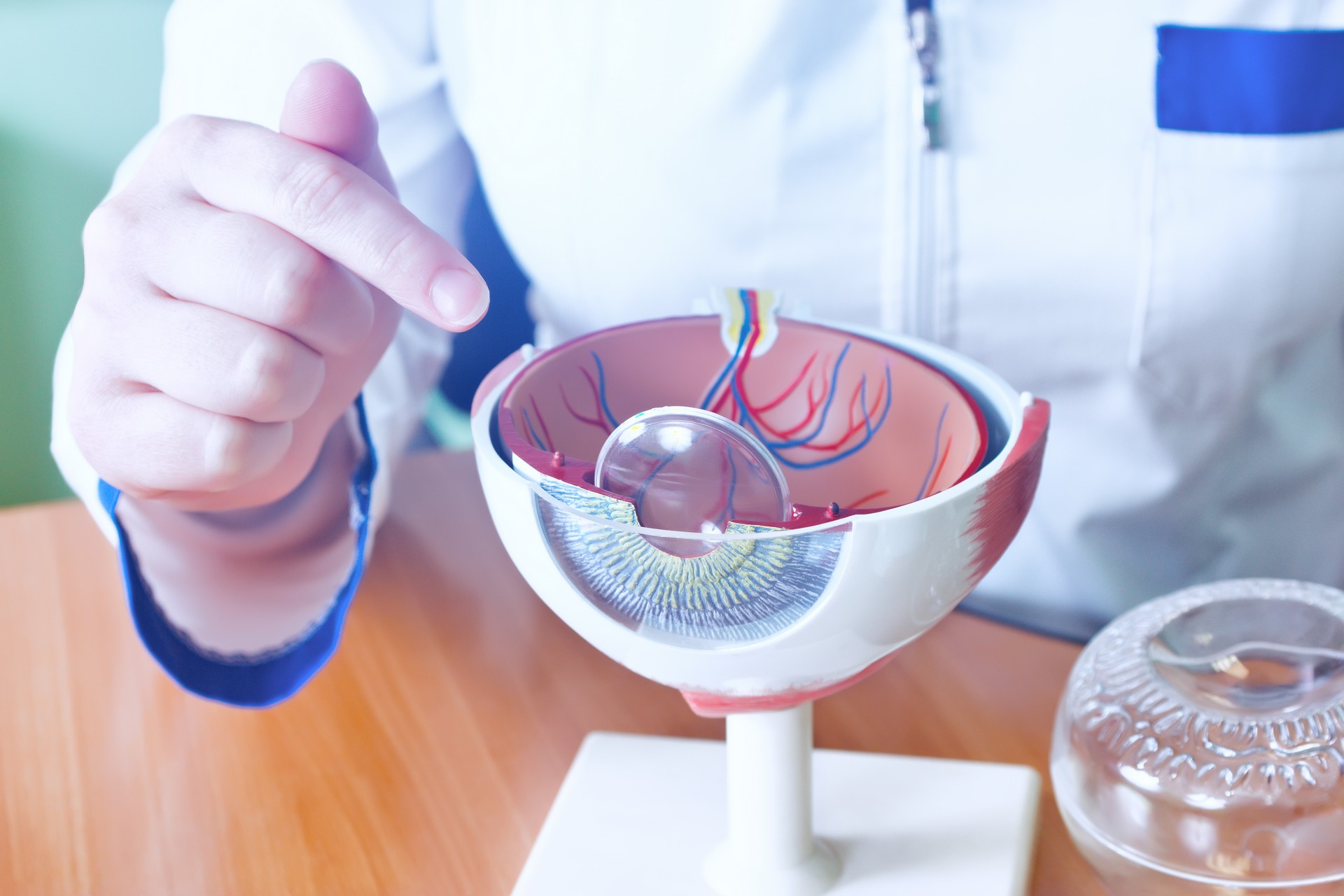
Why do we need this oil? Your tear has three layers:
- On the cornea is the mucin layer.
- The main, aqueous layer – provides moisture.
- The outer, lipid layer – acts like a lid!
This lipid layer, produced by the Meibomian Glands, prevents water from evaporating too quickly. If the glands don’t work, the water escapes. That’s exactly why you feel dryness, even when you’re crying!
Pathomechanism of DES
It’s like a vicious cycle that keeps spinning. If there’s a lack of lipid (oil), the tear evaporates too quickly. This water loss increases salt concentration (that’s hyperosmolarity), which in turn triggers inflammation. This inflammation damages the eye, which further worsens tear quality and closes the cycle. We must break it! Remember also that DES can be a signal that something more is happening in the body, for example Sjögren’s Syndrome – an autoimmune disease.
Dr. Victor Derhartunian has a clear message:
“For us surgeons, tear film stability is the foundation. Without it, we can’t proceed – especially before laser correction. MGD must not be ignored! When we see how this vicious cycle from lipid deficiency leads to permanent damage through inflammation, we know we must act comprehensively. That’s why we thoroughly diagnose DES before every procedure, so that after correction you can enjoy not only sharp but also comfortable vision.”
Symptoms and Diagnosis of Dry Eye Syndrome
Characteristic Symptoms
How can you tell if you have DES? Listen to your eyes:
- Evaporative DES (EDE): Expect burning, stinging, a sensation of grit, and terrible contact lens intolerance.
- Aqueous Deficiency DES (ADDE): You’ll feel redness, fatigue, and light sensitivity. And if you often have dry mouth – definitely tell your ophthalmologist! This could be key to detecting Sjögren’s Syndrome.
Diagnostic Methods
At Swisslaser, we don’t guess. We use a comprehensive diagnostic plan:
- Tear Film Break-Up Time Test (BUT): We stain the eye with yellow dye (fluorescein) and time how quickly your tear “breaks.” A result below 10 seconds is an alarm signal.
- Schirmer Test: We use small strips of blotting paper under the eyelid. We measure the amount of tears – without anesthesia it shows total production (normal is about 15 mm of wetting), with anesthesia it measures only basal production.
- Advanced diagnostics: We go deeper! We check inflammatory markers in tears (e.g., MMP-9). This allows us to see how severe the inflammation is.
- MGD diagnosis: We carefully examine the eyelid margins and check what the gland secretion looks like (MG expression).
Modern Treatment of Dry Eye Syndrome
Basic Medications and Therapy
What do we do to help you? We start with tear supplementation – that is, using artificial tears. They are essential because:
- They reduce friction – your eyelids will glide smoothly.
- They help distribute the remaining lipid layer.
- They flush out toxins.
We most often recommend preparations with sodium hyaluronate, because it not only moisturizes but also supports healing of damaged epithelium. We also have ultra-modern emulsions and nanoemulsions that can replace all three tear layers at once!
Treatment of Meibomian Gland Dysfunction (MGD)
If you have MGD, we need to focus on those small glands:
- Home methods: Regular warm compresses on the eyelids and massage.
- Mechanical intervention: We clean the eyelid margins and compress the glands (expression) to remove blocked, solidified lipid.
- Advanced techniques: If the openings are overgrown, we perform puncture and recanalization with a special Maskin needle.
- Modern devices: We embrace innovation! We use OptiLIGHT and E-EYE devices, which through pulsed light enhance the function of the Meibomian Glands.
FAQ – Frequently Asked Questions
1. Does Dry Eye Syndrome disqualify me from laser vision correction?
Don’t worry, not necessarily! Active DES prevents the procedure. But we treat you first! Thanks to our precise diagnostics and effective treatment, we are able to stabilize your tears, and only then safely qualify you for correction.
2. How long do I need to use artificial tears?
Because DES is a chronic disease, artificial tears often need to be used long-term or cyclically, especially during difficult times for the eyes (e.g., winter, air conditioning). However, the key is MGD treatment – if we restore gland function, we will significantly reduce your dependence on drops.
3. Can MGD be completely cured?
MGD is more like a chronic tendency. You won’t “cure” it completely like a cold, but we can restore and maintain proper Meibomian gland function! You just need to remember regular check-ups and maintenance therapy.
4. Does patient age matter in DES?
Yes. The risk of DES increases with age. Sometimes it’s simply due to age-related changes in the body. This requires particularly thorough and long-term care from us.
5. Is DES hereditary?
DES itself is not a typical hereditary disease. However, if you have autoimmune diseases in your family (such as Sjögren’s Syndrome), you have a greater predisposition to developing DES. We always discuss this during the medical history.
6. How to get rid of dry eye syndrome?
Complete elimination is difficult because it’s a chronic disease, but it can be effectively controlled: preservative-free artificial tears, eyelid hygiene and warm compresses, screen breaks, air humidification, and for Meibomian gland dysfunction – IPL treatments that treat the cause, not just the symptom.
7. How does a person with dry eye syndrome see?
The image periodically blurs, especially at the end of the day and with prolonged screen viewing; blinking briefly sharpens it. In addition, there is burning, a gritty sensation, redness, and paradoxically, tearing in wind or cold.
8. What helps with dry eye syndrome?
The best approach is a combination: moisturizing drops tailored to the type of dry eye, a diet rich in omega-3 fatty acids, the 20-20-20 rule at the computer, sleep and hydration, and eyelid treatment. “Anti-redness” drops that constrict blood vessels are harmful – do not use them chronically.
9. Can dry eye be treated with laser?
Laser does not treat dry eye, but IPL light applied to the eyelid skin unclogs the Meibomian glands and reduces inflammation – it is currently the most effective causal therapy for dysfunction of these glands. A course typically consists of 3–4 sessions at 2–4 week intervals.
Dry eye has become a lifestyle disease – in front of a screen we blink up to half as often, and each incomplete blink means worse Meibomian gland function. That’s why we don’t treat only the symptoms with drops, but the cause: IPL light restores gland function, and the effect lasts for months.
Dr. med. Victor Derhartunian, FEBO, FWCRS
Next step: book dry eye diagnostics (200 PLN, Warsaw or Krakow) – therapy is conducted by our experienced, highly qualified optometrists.
Content medically verified by Dr. med. univ. (Vienna) Victor Derhartunian, FEBO, FWCRS · Last updated: October 2, 2026