Have you noticed that the image before your eyes has recently lost its colors? Maybe driving at night has become a challenge, and you blame it on fatigue or simply your age? We often look for excuses, while our eyes are trying to tell us something. At Swisslaser clinics in Warsaw and Krakow, we meet people every day who think that “it just has to be this way.” Well, it doesn’t have to be!
What will you learn from the text below?
- What exactly is a cataract?It is nothing more than the clouding of the lens inside your eye, which makes it difficult for light to “break through” to the retina.
- What signals should concern you?If you see the world as if through a dirty window or colors have suddenly faded, your eyes may need help.
- Are eye drops enough?Unfortunately, no medications can reverse changes in the lens – the only effective way is to replace it with a new one.
- Why shouldn’t you delay?Waiting too long hardens the cataract, which complicates the surgery and can lead to dangerous spikes in eye pressure.
- What do you gain with modern lenses?By choosing the Premium option, you can get rid of both cataracts and reading glasses or astigmatism in one go.
What is a cataract and why should it not be underestimated?
Mechanism of formation: What causes lens clouding?
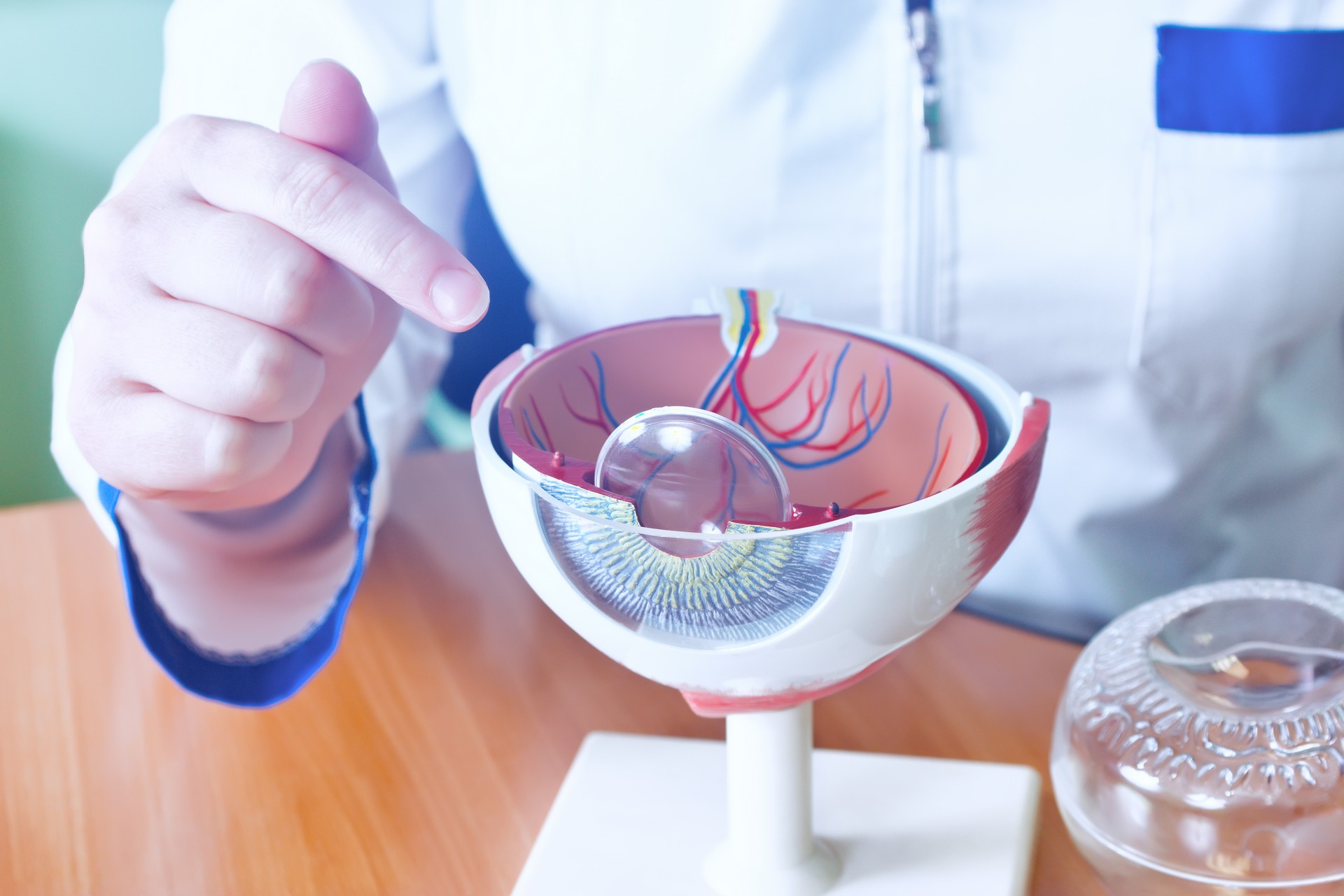
Imagine your eye is a camera. Inside, there’s a lens that should be crystal clear. Over the years, however, the proteins contained within it begin to “curdle” – a bit like egg white in a pan. The result? The lens loses its transparency. Light, instead of freely entering, scatters, and you see less and less. This is a physical process that cannot be stopped by diet or supplements.
Causes and risk factors: Not only age matters
Have you ever wondered why some people get cataracts in their forties? Although age plays a major role here, the list of “culprits” is longer. Diabetes can significantly disrupt eye metabolism, as can long-term steroid use or old injuries. If your parents had surgery early, you should also be vigilant. Cataracts don’t ask for an ID – they can surprise you earlier than you think.
How to recognize the first symptoms of cataracts?
The world “through a dirty window” – characteristic changes in vision
It doesn’t happen overnight. It’s a process that’s easy to get used to. First, you feel like the windows in your house are perpetually dirty. Then you notice that your white shirt has turned beige in your eyes, and evening streetlights have strange halos. Isn’t it frustrating when, despite a sunny day, you feel like you’re in a fog? Paradoxically, with cataracts, you might see better on cloudy days, because with less light, the pupil dilates and “bypasses” the central clouding.
When to see an ophthalmologist? The limit of visual acuity
Forget the old stories that cataracts must “mature.” That’s a myth that has caused a lot of harm!
Dr. Victor Derhartunian states clearly: “There’s no point in waiting until the world turns completely gray. We operate when the drop in visual acuity reaches 30-40%. Why? Because then the procedure is safest, and the patient recovers fastest. Waiting for cataracts to ‘mature’ is an unnecessary risk to the health of the entire eye.”
Consequences of ignoring the problem – from glaucoma to dementia
Ophthalmological complications: Lens hardening and glaucoma risk
When you postpone the decision about surgery, your lens not only clouds but also swells and hardens. It gets tight in the eye. This can block the natural flow of fluids and suddenly “shoot up” intraocular pressure. Such a glaucoma attack is an emergency – the pain is immense, and vision is immediately threatened. Why subject yourself to such stress?
The impact of cataracts on overall health and mental fitness
Do you know that your eyes and brain are connected vessels? When your eyes stop providing clear images, your brain starts to “get lazy” and processes stimuli worse. Studies show that hearing loss and poor vision are a direct path to faster dementia development. By taking care of your eyes, you are actually taking care of your mind’s fitness for years to come.
Modern methods of surgical treatment
At Swisslaser, we don’t use methods from a decade ago. Today, eye surgery is precision that seemed like science fiction not long ago.
Phacoemulsification – painless cataract removal with ultrasound
Sounds complicated? In practice, it’s a quick and safe method. We make an incision smaller than a pinhead, insert an ultrasonic tip that breaks up the clouded lens and gently flushes it out. Everything takes about fifteen minutes, and you are under the care of staff the whole time, feeling only a slight cooling of the eye.
Precision of femtosecond laser in eye surgery
Cataract surgery is performed using ultrasonic phacoemulsification through a micro-incision, in Warsaw and Krakow. We no longer use femtosecond lasers: large randomized studies have not shown that they improve safety or visual acuity compared to phacoemulsification in the hands of an experienced surgeon.
Choosing an artificial lens – what should you know?
Standard lenses under NFZ vs. Premium lens options
This is a crucial moment of choice. A standard lens from the NFZ (National Health Fund) will give you a clear image, but usually only for distance. This means you will still be looking for glasses to read or check the time on your watch. Premium lenses are a different league. They can correct astigmatism and provide good vision at any distance. Can you imagine life without glasses after sixty? It’s possible!
Frequently Asked Questions (FAQ)
1. Does it really not hurt?
We promise – it doesn’t hurt. We anesthetize your eye with special drops. You may only feel a slight pressure or touch, but pain simply does not occur.
2. When will I be able to see normally after the surgery?
Most patients see significantly better the day after the procedure. Full brightness and sharpness of the image usually return after a few weeks, once the eye has fully healed.
3. Can cataracts recur?
An artificial lens does not cloud, so cataracts will not return. Sometimes, so-called secondary cataracts (clouding of the eye capsule) may appear, but we remove them in a minute during a follow-up visit using a laser. Painlessly!
4. Do I need to take a long time off work?
If you don’t do physical work in difficult conditions, you can return to activity quite quickly. Of course, it’s worth giving yourself a few days for a calm recovery.
Do you feel your eyesight is playing tricks on you?Don’t wait until the world turns completely gray. Visit us in Warsaw or Krakow – we will check what is happening with your eyes and together find the best solution.