
SwissLaser in numbers: over 25,000 refractive procedures and approximately 1,500 phakic lens implantations by the lead surgeon · ICL in three countries: Poland, Austria, Switzerland · qualification with MS-39 tomography · same price in Warsaw and Krakow.
ICL lenses in Krakow — shortest answers
- How many years do phakic lenses last?
The ICL lens is intended to remain permanently and does not wear out. Replacement may be needed if cataract develops with age — the ICL is then removed together with the natural lens and an intraocular implant is inserted. For some patients, that moment never comes. - What are the advantages and disadvantages of phakic lenses?
Advantages: no corneal tissue is removed, natural accommodation is preserved, correction range is greater than with laser, and the procedure is reversible. Disadvantages: it is an intraocular operation, possible temporary pressure increase and halo effect at night, endothelial cell monitoring required, and it does not solve presbyopia. - What are the opinions about phakic lenses?
Patients with high myopia most often describe a dramatic improvement in vision quality — greater than after laser, because the image does not lose contrast. Critical reports usually concern night phenomena in the first weeks and cost. Disappointments most often stem from incorrectly sized lenses, which is why qualification is more important here than with laser. - How much does phakic lens implantation cost?
11,000 PLN per eye, including toric version at no extra charge. Qualification examination 400 PLN. ICL lenses are approved between ages 21 and 60, with stable refraction also from age 18.
EVO Visian ICL phakic lenses for patients from Krakow and Małopolska: qualification with MS-39 tomography, lens size selection, procedure, and all follow-ups take place at our clinic at ul. Kluczborska 15/U3 in Krakow. Operated by Dr. med. Victor Derhartunian, who has performed approximately 1,500 phakic lens implantations. Price: 11,000 PLN per eye – one rate for every variant, including toric. Qualification examination: 400 PLN.
Laser or ICL lens? The decision is made at qualification in Krakow
At qualification in Krakow, we first check whether the eyes are suitable for laser correction. We propose a phakic lens when laser would be a compromise or is not an option at all—ICL corrects the defect without removing corneal tissue, because the implant sits behind the iris, in front of the eye’s natural lens.
- Cornea too thin or irregular for laser: with ICL, corneal thickness does not limit correction.
- High defect: myopia up to −20 D and hyperopia up to +10 D—in this range, laser would often have to remove too much tissue.
- Tendency toward dry eye: the procedure affects corneal nerves to a lesser extent than laser correction.
- Reversibility: the lens can be removed or replaced; laser changes the cornea permanently.
If test results favor laser, we will discuss it on the spot—in Krakow we also perform laser eye correction.
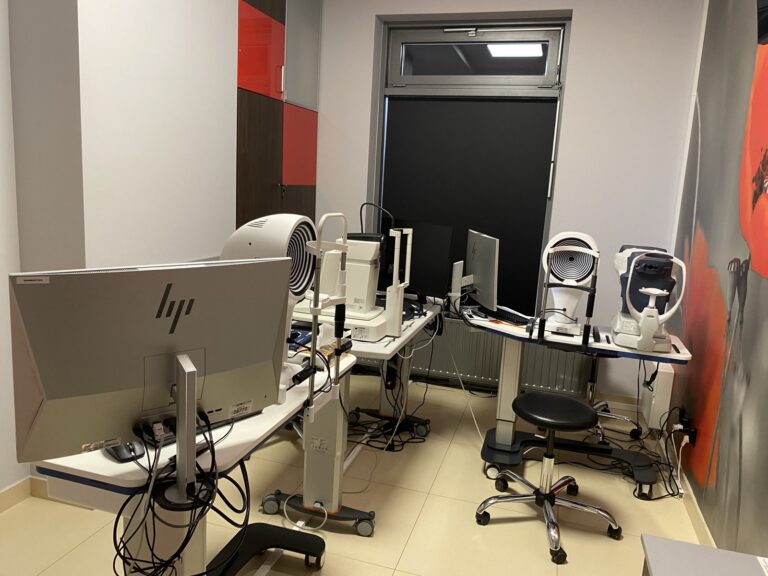
Eye measurement in the diagnostic lab at Kluczborska
The safety of the ICL lens depends on selecting its size. This determines the vault, i.e., the distance between the implant and the eye’s natural lens—too small or too large is the most common cause of complications and repeat procedures described in the literature.
In the Krakow diagnostic lab, we measure the anterior segment of the eye with a second-generation MS-39 tomograph with axial length measurement, assess corneal endothelial cells, and create a three-dimensional model of the eye. We select the lens size from this model, not from a table—before the decision to proceed is made.
Qualification for ICL lenses in Krakow—who is suitable
- Usually yes: people aged 21–60 (with stable defect from age 18), whose defect has not changed for at least a year, with a sufficiently deep anterior chamber and a normal endothelial cell count.
- For individual assessment: history of glaucoma, previous eye procedures, shallow anterior chamber, or early changes in the natural lens.
- Probably not: active eye inflammation, clearly reduced endothelial cell count, or a defect that is still changing. After about age 45, when presbyopia sets in, refractive lens exchange in Krakow is often better.
Three visits at ul. Kluczborska—from qualification to follow-up
- Visit 1—qualification (approx. 90 minutes, 400 PLN): tomography, biometry, endothelial assessment, and lens size selection. The lens is ordered individually to the eye’s parameters.
- Visit 2—procedure (10–20 minutes per eye): anesthesia with drops, incision of about 3 mm, no sutures. You return home the same day, with an accompanying person.
- Visit 3—follow-up the next day, and two more in the first month—included in the package price.
Vision usually stabilizes within the first few days. Return to desk work typically occurs after about 3 days, to sports after 2 weeks.
Six stages of ICL lens implantation
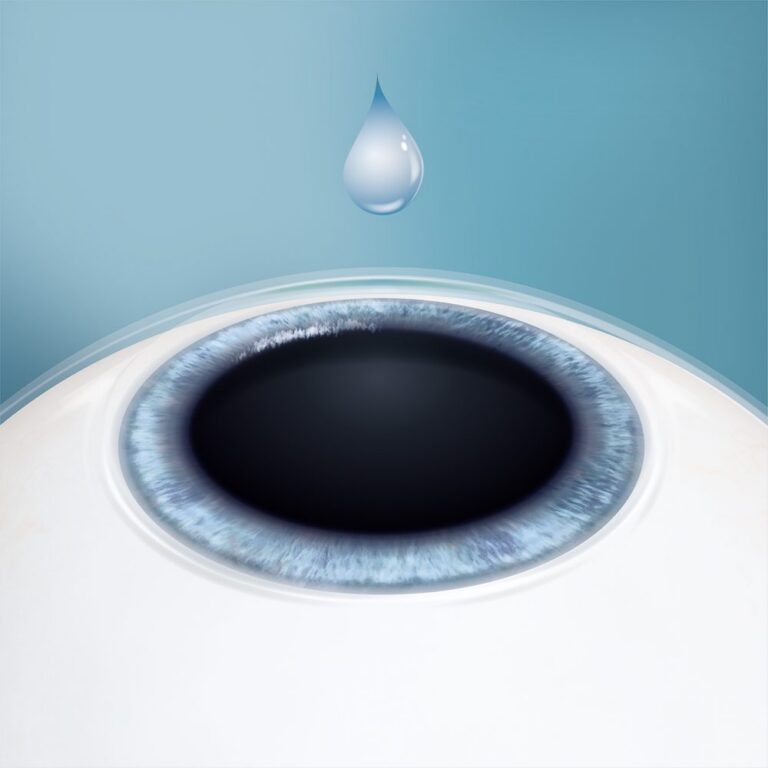
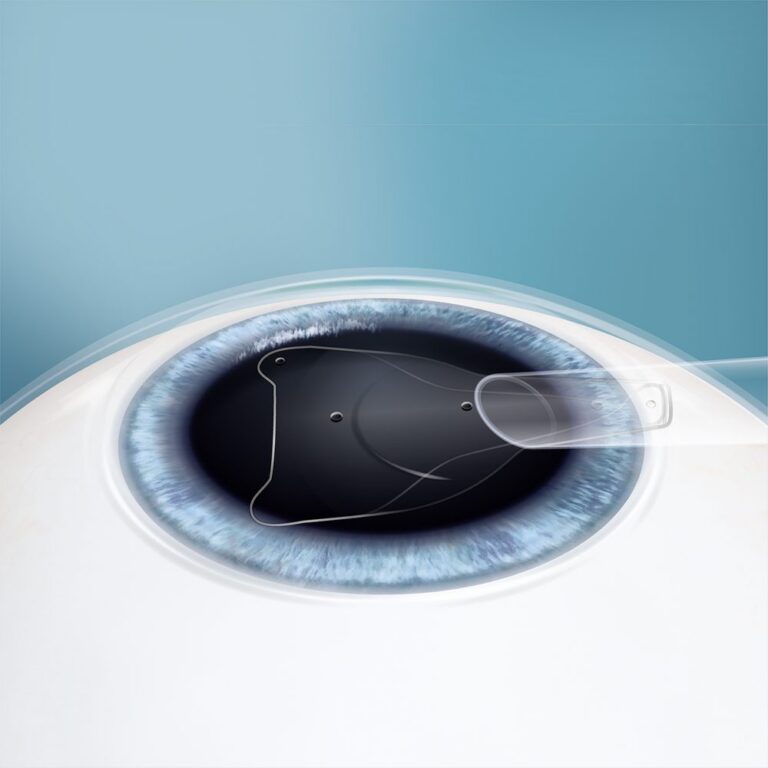
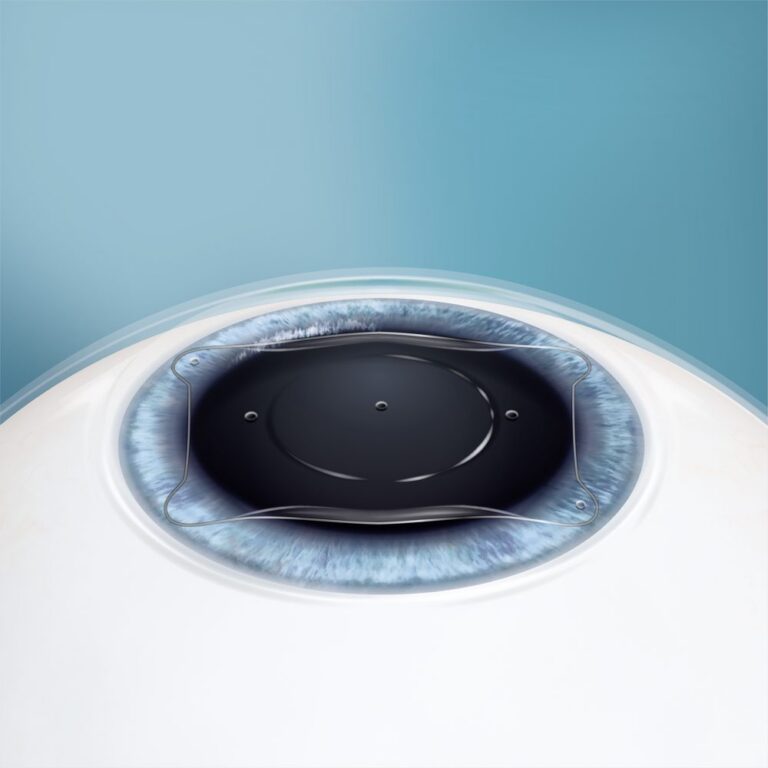
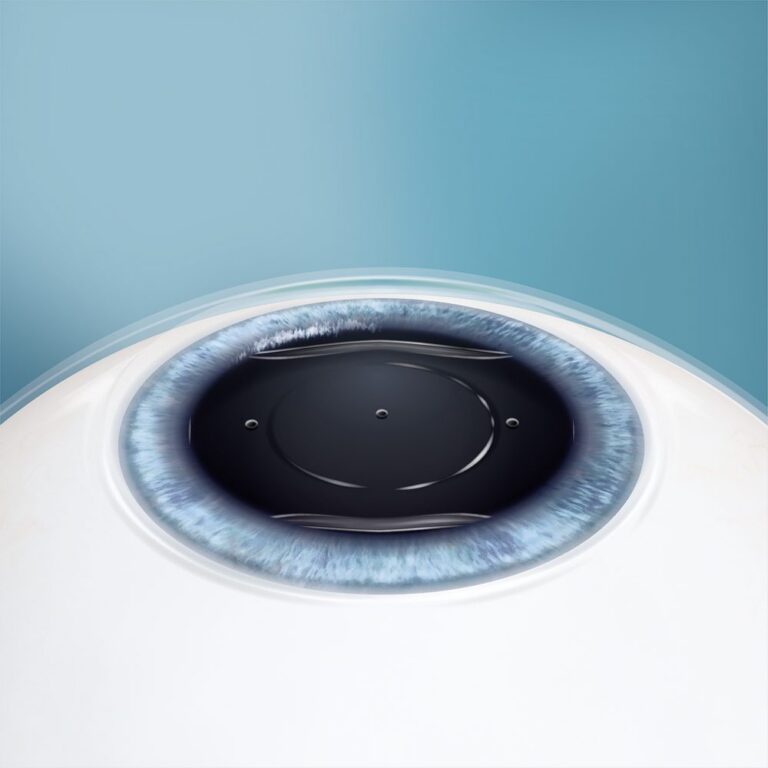
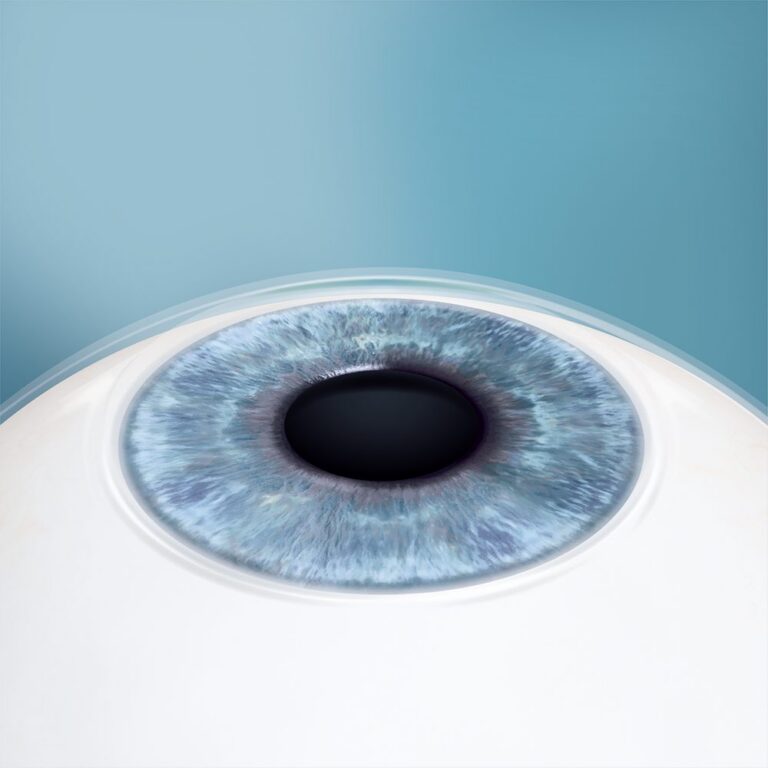
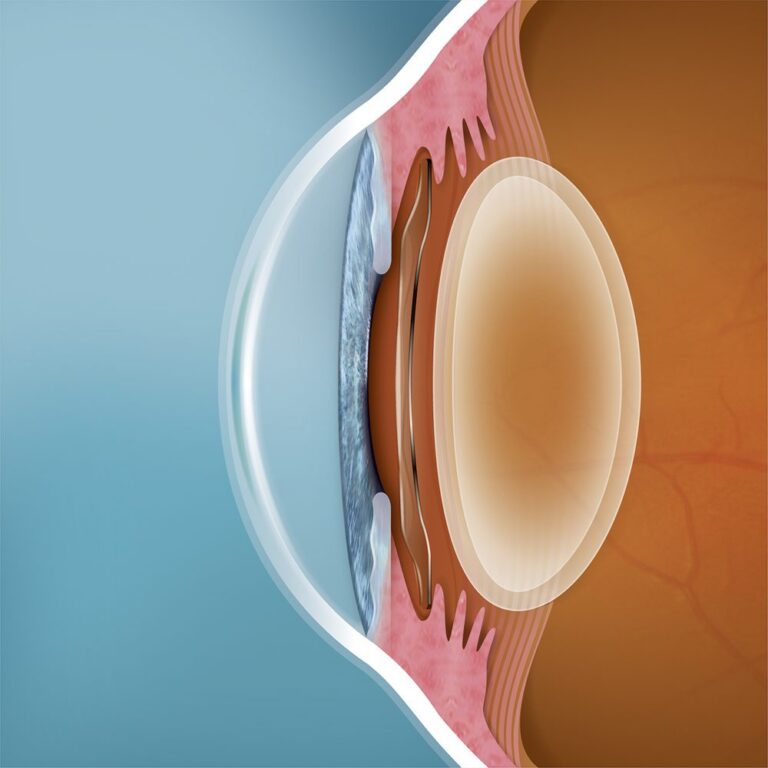
Stage illustrations: STAAR Surgical.
EVO ICL vs. earlier generations of phakic lenses
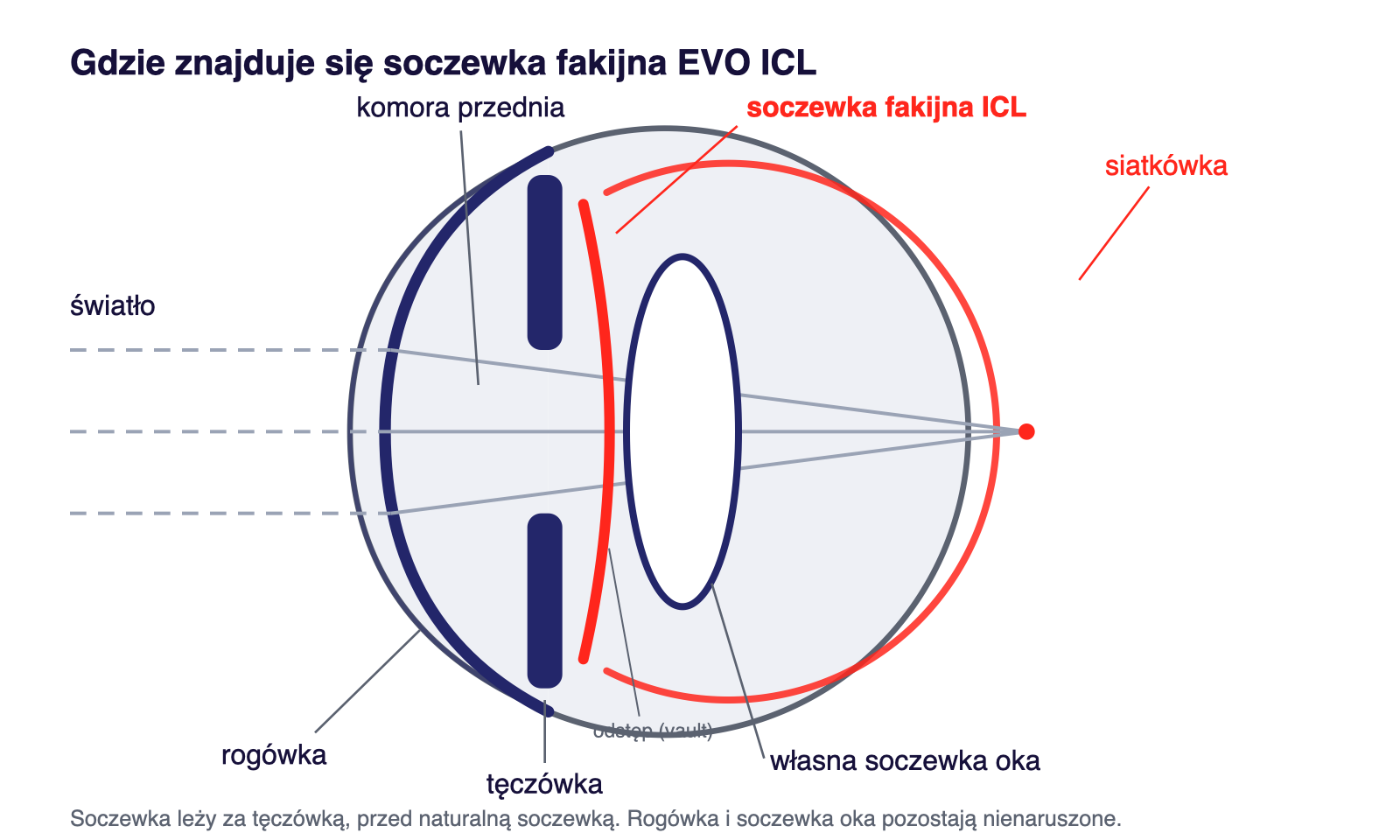
Older phakic lenses required iridotomy – an additional laser incision in the iris to ensure aqueous humor flow in the eye. This was a separate procedure before the actual implantation.
- Central AquaPort hole.The EVO lens has a hole in the central part through which aqueous humor flows naturally. Iridotomy is not needed – one procedure eliminated along with its associated risk.
- Size selection based on 3D model.MS-39 tomography allows simulation of lens positioning before the procedure (vault prediction). Proper vault – the gap between the phakic lens and the eye’s natural lens – is the main safety factor over decades.
- Endothelial assessment before qualification.We count corneal endothelial cells. This layer determines corneal transparency and its reserve does not regenerate – that is why it is a qualification criterion, not a formality.


The design is the same—only the central opening differs. Diagrams: STAAR Surgical.
ICL lens price in Krakow
- 11,000 PLN per eye—in every variant (Myopic, Myopic Toric, Hyperopic, Hyperopic Toric); there is no extra charge for astigmatism correction.
- Qualification: 400 PLN—full examination with tomography in Krakow.
- The package includes the procedure, EVO/EVO+ lens, and follow-ups in the first month.
- The price in Krakow is the same as in Warsaw. Payment is also possible in installments (Santander Consumer Bank).
Phakic lens price list with package details
Patient opinion after ICL lenses (video)
Mr. Rafał had −8 D and chose phakic lenses because—unlike laser—they can be removed if needed. In the recording he describes what qualification, the procedure itself, and the first week looked like: “As soon as you put the lens in my eye, I could see without any problems.”
A summary of the entire conversation is on the phakic ICL lenses page, and patient reviews from Google—including from our Krakow clinic—are collected on the phakic lenses—patient reviews page.
For patients from Silesia, Kielce, Tarnów, and all of Małopolska
The clinic at ul. Kluczborska 15/U3 in Prądnik Biały is located on the route to Katowice and Kielce, with parking spaces under the clinic. This is how we plan treatment for patients from the region:
- Katowice, Gliwice, Tychy, all of Silesia: A4 motorway about one hour, train to Krakow Główny 1 hr 10 min. Qualification and procedure in two visits; next-day follow-up at the clinic.
- Kielce, Tarnów, Nowy Sącz, Bielsko-Biała: 1–1.5 hours; with a morning appointment, qualification fits in one day.
- Rzeszów, Opole: online consultation possible before travel to rule out pointless journey when eye anatomy does not allow the procedure.
- After the procedure: you do not drive, an accompanying person is needed; we operate both eyes as standard during one session, on request in separate appointments.
More about the method, qualification, and risks: phakic ICL lenses – compendium. Before you come, complete preliminary online qualification.
ICL or refractive lens exchange? Age draws the line
This question is asked by most patients who come across both methods while searching online. Both procedures implant a lens inside the eye — but they do completely different things.
- Phakic ICL lens leaves the eye’s natural lens in place. We place the implant in front of it, behind the iris. Accommodation — the ability to focus at close distances — is preserved. This matters before age 45.
- Refractive lens exchange removes the natural lens and replaces it with an implant. Accommodation disappears permanently, but in return cataract will never develop, and a multifocal implant also corrects near vision.
That is why the boundary runs roughly at age 45. Below it, removing a healthy, flexible lens would mean losing accommodation that the eye still has — and that is why ICL gives the most before age 45, although approval covers ages 21–60. Above that boundary, the natural lens loses flexibility anyway, so its replacement ceases to be a loss and becomes a solution. Details: refractive lens exchange in Krakow.
Age is not a formality here. It determines whether the procedure takes something from the eye or only adds.
Dr. med. Victor Derhartunian, FEBO, FWCRS
What to expect after the procedure — day by day
- Day of procedure. Implantation takes several minutes per eye, under drop anesthesia. For a few hours vision is blurred, the eye may sting. You go home the same day — but not behind the wheel.
- Next day. Follow-up at the clinic. Most patients already see clearly and describe it as a dramatic change, especially with high myopia. We measure intraocular pressure and lens position.
- First week. Anti-inflammatory and antibiotic drops as instructed. No pool, sauna, or rubbing eyes. Office work usually possible after about three days.
- First month. Halos may appear around lights after dark — for most patients they fade within a few weeks as the brain adapts to the new image.
- Beyond. Follow-ups at 1, 3, and 12 months, then once a year. We check primarily pressure and corneal endothelial cell count. Annual follow-ups can be done with an ophthalmologist in your city.
Risks we talk about openly
Phakic lens is an operation inside the eye, not a surface procedure. There is no point downplaying this — below is what can actually happen.
- Intraocular pressure increase, most often in the first days. That is why next-day follow-up is mandatory, not optional.
- Incorrect distance between implant and natural lens (vault). Too small or too large means lens replacement with a different size. This is the main cause of reoperation described in the literature and the reason we select size based on MS-39 tomography, not from a table.
- Corneal endothelial cell loss. Progresses slowly, which is why we measure it at every annual follow-up.
- Cataract. Risk is low with properly sized lens, but not zero.
- Night phenomena — halos and glare. For some patients they persist longer, especially with wide pupils.
- Infection, as with any intraocular operation — rare but possible.
What ICL does not solve: presbyopia. After age 40–45, reading glasses will be needed just as before the procedure. We say this before qualification, not after.
Night vision after ICL lens implantation
Driving after dark is one of the first questions at qualification. That is why we measure pupil diameter in low light and select the lens so its optical zone covers it. Halos around lights, if they appear, usually fade within a few weeks.


Illustrative image, not a specific patient result. Material: STAAR Surgical.
Does NFZ reimburse phakic lenses?
No. Phakic lens implantation is a refractive procedure — it removes a refractive error, not a disease — and is not included in the basket of guaranteed services. Neither the degree of refraction nor contact lens intolerance changes this. What NFZ reimburses in ophthalmology is described on a separate page: ophthalmology on NFZ in Krakow.
Questions about ICL lenses in Krakow
How much do phakic ICL lenses cost in Krakow?
11,000 PLN per eye—the same for both spherical and toric versions, with no extra charge for astigmatism. In addition, a one-time qualification examination for 400 PLN. The price in Krakow is the same as in Warsaw; in Poland, the procedure typically costs from about 6,600 to 12,800 PLN per eye, depending on the lens model and package contents.
How do I schedule a qualification for ICL lenses in Krakow?
You can book an appointment online at Book a visit—Krakow or by phone at +48 12 383 33 60. The examination takes about 90 minutes and costs 400 PLN—after it, you know whether ICL is the right method for you.
How many visits in Krakow need to be planned?
Usually three: qualification, the day of the procedure, and a follow-up the next day. In the first month, there are two follow-ups included in the package, then annual examinations—these can be done with an ophthalmologist in your own city.
Where in Krakow do you implant phakic lenses?
At the SwissLaser clinic at ul. Kluczborska 15/U3 in Prądnik Biały—on the ground floor, with entrance directly from the street. Qualification, procedure, and follow-ups take place in the same location.
Can patients from Katowice and Silesia have ICL procedure in Krakow?
Yes. From Katowice, the drive via the A4 motorway takes about an hour. Qualification and the procedure are separate visits, the next-day follow-up takes place at the clinic on Kluczborska, and further annual follow-ups can be done closer to home.
Who performs the procedure in Krakow?
Every procedure in Krakow is performed personally by Dr. med. Victor Derhartunian, FEBO, FWCRS—a refractive surgeon who has performed approximately 1,500 phakic lens implantations.
When is an ICL lens better than laser?
When the cornea is too thin or irregular, the defect is high (myopia up to −20 D, hyperopia up to +10 D), or the eye has a tendency toward dryness. An additional argument: the lens can be removed later.
Can ICL lens implantation be reversed?
Yes. The lens can be removed or replaced with another, and the eye returns to its pre-procedure state—unlike laser, which permanently changes the shape of the cornea.
How long does the ICL lens stay in the eye?
Indefinitely—the lens does not require scheduled replacement. At follow-ups we check its position (vault) and endothelial cell count; if anything changes, it can be removed or replaced.
Does the ICL lens correct astigmatism?
Yes, in the toric version. In Krakow it costs the same as a spherical lens—11,000 PLN per eye.
Can you see or feel the ICL lens?
No. It sits behind the iris, so it is not visible from the outside, and—unlike contact lenses—you cannot feel it in the eye.
What if cataract develops later?
Then during cataract surgery we remove the ICL lens and implant an artificial intraocular lens in place of the clouded one. Prior ICL implantation does not complicate cataract surgery.
Up to what age can ICL lenses be implanted?
ICL lenses are approved for use in people aged 21–60, with stable defect also from age 18. However, they offer the most benefit before about age 45—later, presbyopia sets in and refractive lens exchange is often more advantageous. Ultimately, the qualification examination decides.
How long does the procedure itself take?
About 10–20 minutes per eye, under anesthesia with drops. You return home the same day with an accompanying person, and the follow-up at the clinic on Kluczborska takes place the next day.
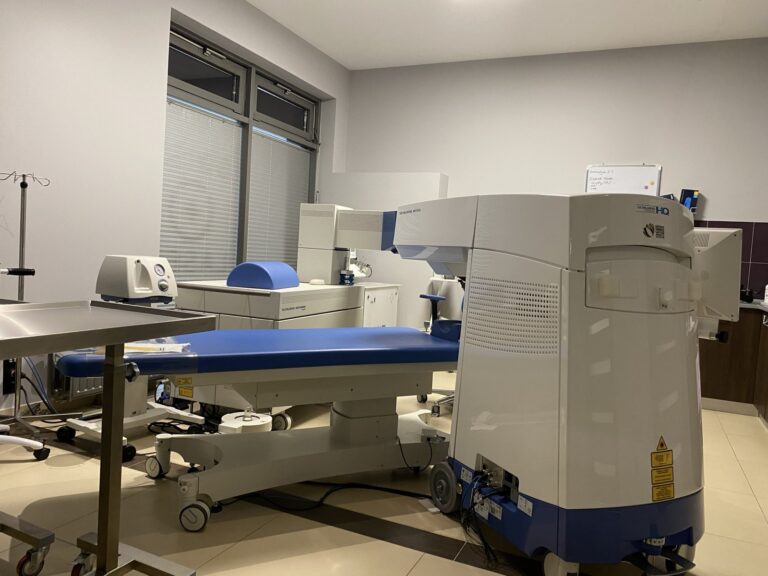
Clinic in Krakow where we implant ICL lenses
Qualification with tomography, procedure, and all follow-ups take place in one location – at ul. Kluczborska 15/U3, with entrance directly from the street.
How to reach us in Kraków
SwissLaser Kraków
ul. Kluczborska 15/U3, 31-271 Kraków
Phone: +48 12 383 33 60
Monday–Friday 8:00–18:00
The clinic is located at the Krowodrza Górka loop, with free parking.
Contact and directions · Book an appointment
Sources
- Packer M. Meta-analysis and review: effectiveness, safety, and central port design of the intraocular collamer lens. Clin Ophthalmol 2016;10:1059–1077. doi:10.2147/OPTH.S111620
- Igarashi A, Shimizu K, Kamiya K. Eight-year follow-up of posterior chamber phakic intraocular lens implantation for moderate to high myopia. Am J Ophthalmol 2014;157(3):532–539. doi:10.1016/j.ajo.2013.11.006
- Kamiya K, Shimizu K, Igarashi A et al. Posterior chamber phakic intraocular lens implantation: comparative, multicentre study in 351 eyes with low-to-moderate or high myopia. Br J Ophthalmol 2018;102(2):177–181. doi:10.1136/bjophthalmol-2017-310164
- STAAR Surgical. EVO/EVO+ Visian ICL – product information and instructions for use (CE). staar.com
Related Topics
Phakic ICL lenses – compendium · Price list and installments · Laser or phakic lens · Laser vision correction · Refractive lens exchange
Content verified by Dr. med. univ. (Vienna) Victor Derhartunian, FEBO, FWCRS – specialist in refractive surgery. Last verification: October 2, 2026.
How to Reach the Clinic in Krakow
ul. Kluczborska 15/U3, 31-271 Krakow – Krowodrza.
Phone: +48 12 383 33 60 · Monday – Friday, 8:00 AM – 6:00 PM
- Bus: Krowoderskich Zuchów stop about 190 m – three minutes on foot.
- Tram: Krowodrza Górka terminus about 350 m, or a 5-minute walk.
- By car: at the Krowodrza Górka terminus, there is a Park and Ride parking lot – leave your car and take the tram.
- Train: Kraków Łobzów station about 890 m.
Other procedures in Krakow
In the same clinic, we also perform:
Laser vision correction
Trans-PRK, FemtoLASIK, SmartSight – from PLN 10,000 for a pair of eyes
Refractive Lens Exchange
solution after age 45, also corrects presbyopia
Cataract Treatment
removal of clouded lens with premium implant
Keratoconus Treatment
cross-linking, CAIRS rings, diagnostics
Presbyopia Treatment
PresbyMAX, EDOF lenses, monovision
Chalazion removal
procedure under local anesthesia, PLN 800 per eye – only in Krakow
E-EYE therapy
dry eye syndrome and Meibomian gland dysfunction – only in Krakow