
Qualification of vision defect for laser correction
About. 90% of patients presenting to ophthalmologists with a specialty in refractive surgery qualify for laser vision correction.


About. 90% of patients presenting to ophthalmologists with a specialty in refractive surgery qualify for laser vision correction.

Until recently, only mature cataracts were operated on; today, ophthalmologists agree that cataract surgery is indicated even in the early stage, provided the visual impairment is significant enough to interfere…

Corneal cone is a progressive eye disease that leads to thinning and distortion of the cornea, with subsequent deterioration of vision – myopia and astigmatism and often hypersensitivity to light.…

The eye is one of the most fascinating and important organs of the human body, allowing us to experience the world through the sense of sight. Its complex structure resembles a precisely designed biological camera, where each element plays a crucial role in the process of vision. Understanding the architecture of the eye is essential for making informed decisions regarding vision correction and maintaining eye health throughout life.
Astigmatism is a common vision defect that affects millions worldwide, often accompanying other vision problems. Although it can significantly impact visual comfort and quality of life, modern medicine offers effective and safe methods for its correction. In this article, we provide comprehensive information on astigmatism – from its causes and symptoms to modern diagnostic and treatment methods available at our clinic.

EDOF (Extended Depth of Focus) lenses represent an innovative advancement in modern eye surgery.

Cataract surgery is a new beginning for your vision. In this article, we discuss in detail all available types of intraocular lenses (IOLs).
The cataract removal procedure itself is surprisingly short – it usually takes 15 to 20 minutes per eye. However, the entire medical procedure, including preparation and the period immediately after…
Imagine that your vision is the most advanced camera in the world. The retina is its film – an incredibly thin layer that captures light and transforms it into the…
Refractive lens exchange, or RLE (refractive lens exchange), involves removing the patient’s natural lens and replacing it with a technologically advanced artificial lens that corrects the vision defect. However, modern artificial intraocular lenses can be selected in such a way that they correct not only refractive errors, commonly known as vision defects, but also other conditions.

Laser eye surgery itself represents an incredible advance over earlier vision correction methods, such as standard scalpel operations.
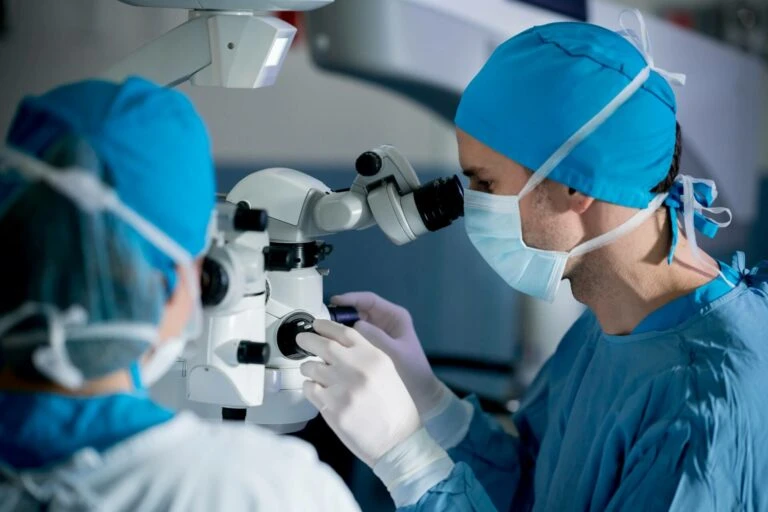
Laser eye surgery is not used in the treatment of strabismus, because the treatment requires intervention in the muscles around the eye, and the laser procedure does not offer such possibilities. But.

Do you have questions, want to consult with our experts or schedule a treatment directly?
ul. Kolejowa 1, 01-217 Warszawa
Monday – Friday: 8:00 – 18:00
ul. Kluczborska 15/U3, 31-271 Kraków
Monday – Friday: 8:00 – 18:00