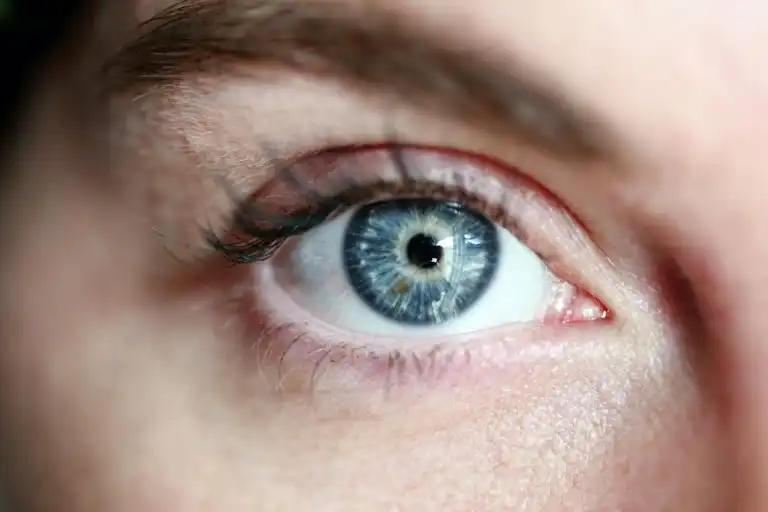
You are lying on the treatment chair, the laser is ready to operate, and panic suddenly erupts in your mind: “What if I blink? What if I suddenly sneeze and my eye moves to the side?” This is absolutely the most common concern our patients in Warsaw and those visiting our clinic offering laser vision correction in Krakow bring into the treatment room. We want to reassure you, however—today’s medicine is light-years ahead of your natural reflexes. Thanks to cutting-edge technology, no blink or slight head movement will compromise the outcome of your procedure.
What will you learn from the text below?
- Can blinking interrupt the procedure?There is no chance of that, because a special speculum gently holds your eyelids open, so blinking during laser operation is simply impossible.
- How does the laser respond to movements of your eyeball?Modern Eye Tracker systems monitor every micro-movement a thousand times per second and immediately adjust the beam or pause the device.
- What happens if you suddenly sneeze?The intelligent safety system will detect the sudden movement in a fraction of a second and immediately stop the laser, waiting until your eye returns to its position.
- What technology watches over you at Swisslaser?We have chosen the seven-dimensional 7D tracking system in the AMARIS 1050 RS laser, which monitors the eye in real time, with no delays whatsoever.
- Where else do people use eye tracking?The same technology helps physicians diagnose autism, allows individuals with disabilities to control computers, and even supports research into our attention.
Fear of moving your eye – why is this your smallest concern?
It is natural to fear losing control over your own body at such an important moment. You must know, however, that laser vision correction today is a process guided by artificial intelligence, which monitors every millimeter of your cornea. Is it not reassuring to have such an advanced “guardian angel” behind you?
Ophthalmic speculum: Your guarantee against blinking
Have you ever wondered how you would endure several minutes without blinking? The answer is simple: you do not have to think about it at all. Before we begin, we place a gentle speculum. Although the name may sound harsh, thanks to anesthetic drops you will not feel it at all. It simply stands guard over your eyelids, protecting you from involuntary movements.
Can sneezing or coughing ruin the outcome of the procedure?
Absolutely not! Even if a sudden coughing fit strikes you, the eye tracker system will react faster than you can think “achoo.” The laser will simply stop emitting and patiently wait until you stabilize your position again. It is a bit like having an intelligent autopilot that immediately corrects the flight at the slightest turbulence.
Laser correction and nystagmus – is it possible?
Imagine that even with nystagmus we can safely perform the procedure. The tracking systems operate at such speed that they easily keep pace with oscillations of the eyeball. They place the laser spot exactly where the physician planned, regardless of how much the eye “wanders.”
Eye Tracker System: How does 7D technology “see” more than a human?
The eye tracker system is the “brain” of the entire operation. Its sole task is to continuously verify that your eye is located exactly where it should be.
A thousand images per second: How does eye tracking analyze the position of your eye?
Imagine a camera that takes 1,000 photographs per second. Impressive, is it not? That is precisely the frequency at which our eye tracker scans your eye. Thanks to this, the system knows about every movement of your gaze, even the most microscopic, before you yourself feel it.
Immediate lockout: What happens when the system detects a sudden movement?
If you move too abruptly, the system immediately compensates for the movement or completely blocks the beam. We have eliminated the risk of damaging healthy tissue, because the laser hits the target with accuracy to one-tenth of a millimeter. You can review all these innovations in the our technologies section, where we describe Swisslaser’s safety standards.
Precision to one-tenth of a millimeter – the standard at Swisslaser
In our clinics, precision is the middle name of every procedure. Thanks to 7D technology, the laser spot lands on the cornea with a level of accuracy that surgeons could only dream of a decade ago. Could you ask for anything more for your safety?
Technology at Swisslaser: Meet the AMARIS 1050 RS excimer laser
At Swisslaser we do not accept half-measures, which is why we work with one of the fastest and most accurate laser systems in the world.
Seven-dimensional 7D motion tracking with no delays
The 7D system in the AMARIS laser monitors the eye in seven dimensions. It tracks not only left-right or up-down movements, but also rotation of the eye and shifts along the depth axis. All of this occurs in real time—with no delay whatsoever.
Wavefront method and personalized (Topo-Guided) procedures
Thanks to such extraordinary precision, we can perform “custom-tailored” procedures based on the unique map of your cornea. We adjust each laser pulse to your individual anatomy. Dr. Victor Derhartunian emphasizes:
“Patients often think they must lie motionless like statues. The truth is that our laser ‘adapts’ to them. The AMARIS 1050 RS system ensures that even if you suddenly jumped up from the chair, the laser would simply stop operating, causing you no harm.”
The role of artificial intelligence in diagnostics and in the operating room
Artificial intelligence supports us at every step—from creating the first map of your vision to the final laser pulse. Thanks to this, procedures are not only safer, but also lightning-fast.
Eye tracking is not just for lasers – where else does this technology work?
It is worth knowing that the technology that saves your vision is also changing the lives of many other people.
From diagnosing autism to controlling a computer with your gaze
Eye tracking helps physicians detect autism in young children more quickly and gives incredible freedom to paralyzed individuals. They can write emails and communicate with the world by controlling a computer using only their eye movements. Is it not fascinating how technology removes barriers?
Neuromarketing and virtual reality (VR)
When you browse a website, eye trackers study where your gaze travels first. The same technology enables your VR headset to know exactly which element of the virtual world you are looking at, making the experience even more realistic.
FAQ – Frequently Asked Questions
1. Does the speculum that prevents blinking hurt?
Not at all. Before we place it, we administer anesthetic drops, so you will feel only gentle pressure. The sensation passes more quickly than you expect.
2. What if there is a sudden power outage at the clinic?
Rest assured. Swisslaser has its own emergency power supply systems (UPS). Even if the entire city were plunged into darkness, our laser would safely complete its work.
3. Does the Eye Tracker work with the same precision for everyone?
Yes, the system calibrates to the unique pattern of your iris. It does not matter what color your eyes are or the size of your pupil—the eye tracker will monitor you with the same Swiss precision.
4. How long does the laser actually operate?
Thanks to the speed of the AMARIS 1050 RS, the actual beam action on the cornea typically takes anywhere from several to several dozen seconds. It truly is the blink of an eye!
5. Can the laser blind me if something goes wrong?
That is physically impossible. The safety systems are redundantly duplicated. If the software detects any error, the laser beam simply will not fire. Your safety is our absolute priority.
Sources
- Kim TI, Alió Del Barrio JL, Wilkins M, Cochener B, Ang M. Refractive surgery. Lancet 2019;393(10185):2085–2098. doi:10.1016/S0140-6736(18)33209-4
- Chuck RS, Jacobs DS, Lee JK et al. Refractive Errors & Refractive Surgery Preferred Practice Pattern. Ophthalmology 2018;125(1):P1–P104. doi:10.1016/j.ophtha.2017.10.003