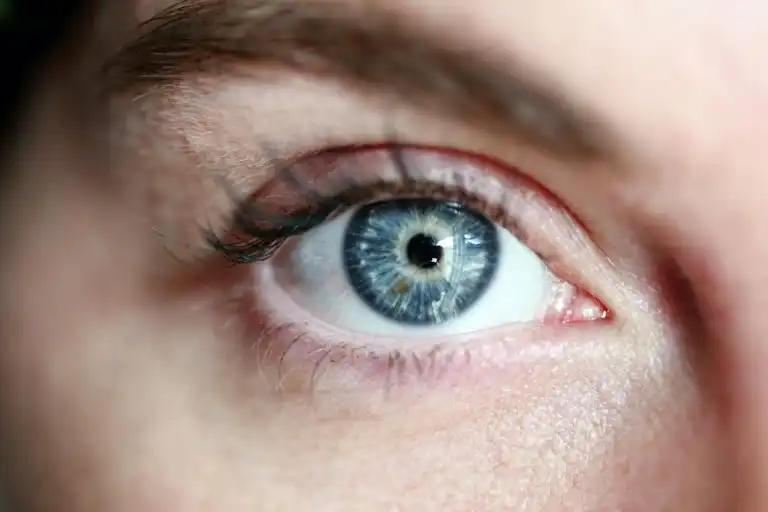
Any surgical procedures performed on the eyeball, but also in the area around the eye, should sensitize us to the safety issues associated with makeup. Even a perfectly healthy eye can react badly to the ingredients of particular cosmetics or their texture. At stake is not only the risk of allergy, but also the possibility of getting under the eyelid or under the contact lens particles of henna used for eyebrow or eyelash coloring, microfibers used in mascara extensions or simply eyeliner residues.
When the eye is healthy, unaffected by any surgical interference, the particles of cosmetic preparations entering it create considerable discomfort, but they are relatively easy to rinse out. If, on the other hand, we are, for example, in the process of convalescence after laser vision correction, getting any foreign bodies into the eye carries the risk of infection and infection, and thus post-operative complications.
Cosmetic particles change the composition of tear fluid
Eyes don’t like it when we use makeup pencils drawing a line on the so-called waterline, that is, on the inner edge of the lower eyelid. This is one of the makeup cardinal sins, committed in spite of the warnings of ophthalmologists, who put it bluntly: eyeliner applied on the waterline quickly gets on the mucous membrane of the eye and, together with the tear fluid, is distributed throughout the eyeball, irritating it as long as it is not completely rinsed away. To put it another way: cosmetic particles change the composition of the tear fluid, and people with sensitive eyes, contact lens wearers, and those suffering from dry eye syndrome can have vision problems as a result.
Laser vision correction vs. risk of cosmetic particles getting into the eyes
We said that the particles of cosmetic preparations getting into it create a lot of discomfort, but they are relatively easy to rinse out. Relatively… After all, you have to remember that eye makeup preparations contain ingredients that make them permanent, that is, they have a high adhesion to the skin.
Waxes, oils, silicone make the crayon or shadows impossible to remove with water alone, requiring reaching for a special makeup remover. Rinsing the eye with saline (which additionally dries out the mucous membrane) or drops containing sodium hyaluronate does not always bring quick cleaning results.
This is well known to any woman whose makeup products have irritated her eye and has trouble getting rid of the sensation of sand under the eyelids. Can you imagine what happens when, disregarding the doctor’s indications, we put on makeup while our eyes are still healing and we are not allowed to use any products to rinse them?
Henna and false eyelashes
When you are in the recovery stage after laser vision correction, you should refrain from wearing eye makeup. For how long? At least 2 weeks, but the doctor will give us precise recommendations right after the procedure. It is also not advisable to use henna or glue on false eyelashes. In the latter case, it is recommended to wait at least 4-6 weeks.
Artificial eyelashes are best removed about 2 weeks before the planned surgery. Both the glue used to attach the lashes and the remover, which is the product used to remove them, can slightly irritate the cornea, so we need to give the eyes time to recover and rest. And while we’re talking about henna, let’s also remember that henna coloring, should not be done at the last minute before the procedure.
Remnants of henna can be left around the eye and get under the corneal flap during the procedure, making the surgeon’s job much more difficult. There is also a risk that such microparticles will simply get stuck in the cornea itself.
The risks of improperly done healthy eye makeup are really disproportionate to the benefits of looking good.
In case one decides to undergo laser vision correction, all recommendations related to makeup application, eyebrow and eyelash coloring or eyelash extensions both before and after the procedure must be strictly followed.
Otherwise, we risk unnecessary complications, which in the case of laser eye treatment occur really occasionally – laser vision correction surgery is successful in about 95% of cases, the number of complications is less than 1% of cases, and the risk of vision loss from laser vision correction performed by an experienced surgeon is too small to measure – it is close to 1 in 5 million. So it would be absurd to lead to complications through one’s own stupidity….