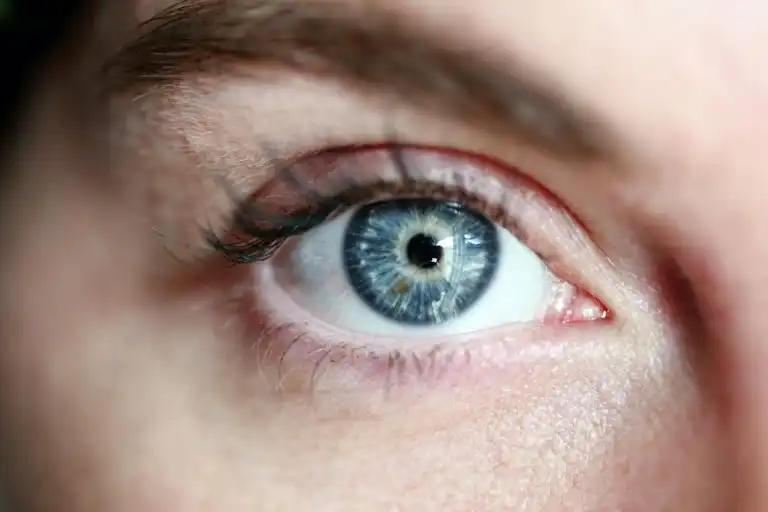
To guard something like the pupil of the eye, to be someone’s eye in someone’s head, to have eyes wide open or to have flip-flops on the eyes… – phraseologisms in which the main role is played by the eye are numerous in the Polish language. It’s hardly surprising: the eye is, right after the brain, the most complicated organ of the human body, which – due to the huge number of nerve connections that would have to be reconstructed – we still don’t know how to transplant.
Here are a handful of interesting facts about our eyes, which, as we say, are the mirror of the soul….
The most important thing is invisible to the eyes….
Let’s start with an obvious fact: it is not the eyes that see, it is our brain that sees. The eyes are only receptors of electromagnetic waves of visible light, which, after passing through the optical system, form a reduced and upside-down image on the retina. It is the light-sensitive retina that converts light energy into the energy of nerve impulses, which are sent to the brain. The eyes provide the brain with stimulus information and it is only the brain that combines the two images into one, “inverts” it, registers it and voilà: a cat, a flower, a Mercedes-Benz.
Interestingly, we come into the world with a brain that has to train the ability to “invert” the image registered with the eyes, which is why an infant only begins to see normally after some time – at first his eyes, pardon me, brain, appear to see the world put on its head.
The retina is an unimaginably sensitive part of our eye’s structure. Located on it are the actual visual cells, the so-called photoreceptors, consisting of about 6 million cones and 120 million rods, thanks to which we distinguish 160 colors and 600,000 shades. However, it is worth knowing that this huge number is still not all the colors that light carries. The human eye perceives colors only in the range of the so-called optical window, that is, in the range of electromagnetic wavelengths from about 380 nm (which corresponds to violet light) to about 700 nm (which corresponds to red light). Infrared and ultraviolet are invisible to us.
The yellow spot, located centrally on the retina and consisting solely of cones, has the greatest sensitivity to light and color.
You already know why the Little Prince said that the most important is invisible to the eyes – one can only truly see with the heart. And with the brain;)
8 grams, 24 millimeters
The eyeball weighs only 8 grams, but is one of the most important and necessary organs for humans. Because of its special role, nature has provided us with two organs of sight. They provide the brain with as much as 85% of information about the environment, for the process of analyzing which more than 10% of all nerve cells in the brain are involved. Thanks to this, a person not only looks, but also understands what he sees.
Only 1/6 of the human eyeball is exposed, with the remainder shielded by the eyelids and stuck securely in the orbit. The eyeball is shaped like a sphere with a diameter of about 24 millimeters. It is mostly filled with the so-called vitreous body, an amorphous substance under pressure that allows it to retain its spherical shape.
Best camera
If the human eye were a camera, it would have 576 megapixels. Compared to a standard 24.2 megapixel camera, the eyes could take incomparably better high-resolution and 3D photos than you’ve ever seen. It’s hardly surprising, then, that for many people the opportunity to see something with their own eyes is so important – no photograph or film can capture beautiful sights (landscapes or works of art) in such a way as to convey their beauty seen in person.
Blue eyes, royal life
The human eye can distinguish more shades of green than any other color in the spectrum, but green iris color happens most rarely in humans. The color of the eyes is determined by the melanin content of the iris epithelium, the melanin content of the iris stroma and the density of the iris stroma cells – the less melanin, the more translucent the collagen, tinting the eyes blue.
Our eye color is an inherited trait. Associated with the vast number of possible combinations of human eye colors are three alternative forms of the same gene: EYCL1, EYCL2 and EYCL3. All of them, responsible for the three phenotypic eye colors (brown, green and blue), must specify the same color for the eye color to be pure. If this is not the case, you will get a mixed color, such as peony (brown + green) or gray (blue + green).
The most common eye color is brown (90%), blue is in second place (7%), and green is the rarest (1%). About 2% of the population has mixed eye color (peony or gray).
Sometimes it is difficult to determine what color someone’s eyes are – they change slightly with lighting. There are also different-colored eyes, a situation in which one eye is a different color and the other a different color. This affliction is called heterochromia and affects about 1% of the population.
The title blue eyes, however, do not necessarily guarantee a royal quality of life. People with this color of irises most often have a very light complexion prone to sunburn and are more likely to develop melanoma (skin cancer).
Blink 10% of life
Blinking, an activity involving the rapid closing of the eye that lasts between 100 and 150 milliseconds, is said to take up as much as 10% of our lives! In one minute, adults blink 12 to 17 times while newborns blink only 1 to 4 times. By blinking, the eye is moistened with the so-called tear film, or simply tears, which have moisturizing and antibacterial properties. Abnormalities in tear film secretion are at the root of a disorder called Dry Eye Syndrome (DS), which you can read more about here https://swisslaser.pl/blog/zespol-suchego-oka-przyczyny-objawy-diagnostyka-i-leczenie/
Blinking is spontaneous and unconscious. The eye also reacts this way to any irritation, such as when a strong wind blows and carries sand or dust, there is too harsh a light, or the eye is tired from staring at the TV or computer monitor for too long.
Iris scan like a fingerprint
A fingerprint has 40 unique characteristics, while a person’s iris has as many as 256, which is why eye scans are increasingly being used for security purposes. Yes, this is no longer science fiction. You can find iris scanners in smartphones, for example. The pattern in which the colored spots in the iris of the human eye are arranged is invariable over time, so that, the iris can act as a biometric security device.