Astigmatism and Laser Correction – in Brief
- Yes – regular astigmatism responds very well to laser correction. The laser evens out the irregular shape of the cornea, removing the cause of image distortion.
- We correct it together with myopia or hyperopia in a single procedure – it is not a separate procedure or an additional cost.
- The limits are set by the cornea, not the defect itself. Qualification is determined by corneal thickness and topography, which we assess with the MS-39 tomographer.
- When laser is not indicated – with a thin cornea or very high defect – the alternative is toric phakic ICL lenses. Details: laser vision correction.
Astigmatism, from the Latin non-compliance, is a truly stubborn visual defect. It’s not simply that you don’t see sharply. It’s a constant distortion of reality! Have you ever seen wavy lines? Or felt that the image is so unclear and blurred, regardless of whether you’re looking near or far? That’s exactly how an astigmatic person feels every day. The constant struggle for sharpness, especially when astigmatism mixes with myopia or hyperopia, leads to chronic fatigue. Fitting glasses or contact lenses then becomes an ordeal. But we have great news! At SwissLaser Clinic, we have the tools that allow us to permanently solve this problem, restoring the world to its true, undistorted shape.
What will you learn from the text below?
- How does an astigmatic person perceive? An astigmatic person cannot achieve sharpness, which causes disturbances in spatial perception, making normal functioning difficult.
- What is the anatomical cause of this defect? The cause is a defective, elliptical structure of the cornea, which causes light to enter the eye through two points instead of focusing at one.
- When do traditional cylindrical glasses cease to be sufficient? Lenses fail when we are dealing with complicated irregular astigmatism or when it is accompanied by another serious defect.
- Is laser correction effective for astigmatism? Yes, the latest technologies allow us to remove astigmatism reaching even approximately 6 diopters, often in combination with correction of another refractive error.
- What are the options for correcting astigmatism when it is accompanied by cataracts? In such a case, we can eliminate both problems simultaneously by implanting toric artificial intraocular lenses.
Astigmatism (Non-Compliance) – Problem with Sharpness and Eye Shape
How does an astigmatic person see the world? (Curvature, waviness, lack of sharpness)
Imagine that you are constantly looking through a slightly wavy, distorted pane of glass, regardless of distance. That’s exactly what an astigmatic person experiences. Not only do they not see sharply, but they also experience constant curvature and waviness of the image, and on top of that, colors are so faded because contrast is weak. The brain and eyes cannot agree to establish a single point of sharpness.
Symptoms accompanying the defect (Headaches, burning, and concentration problems)
This struggle for sharpness quickly exhausts! No wonder that in addition to problems with vision itself, astigmatic people complain of troublesome symptoms. Headaches and dizziness are the norm. Their eyes also often burn and water, especially when they try to save themselves by constant squinting. It’s simply a permanent problem with concentration.
Eye shape and mechanism of defect formation
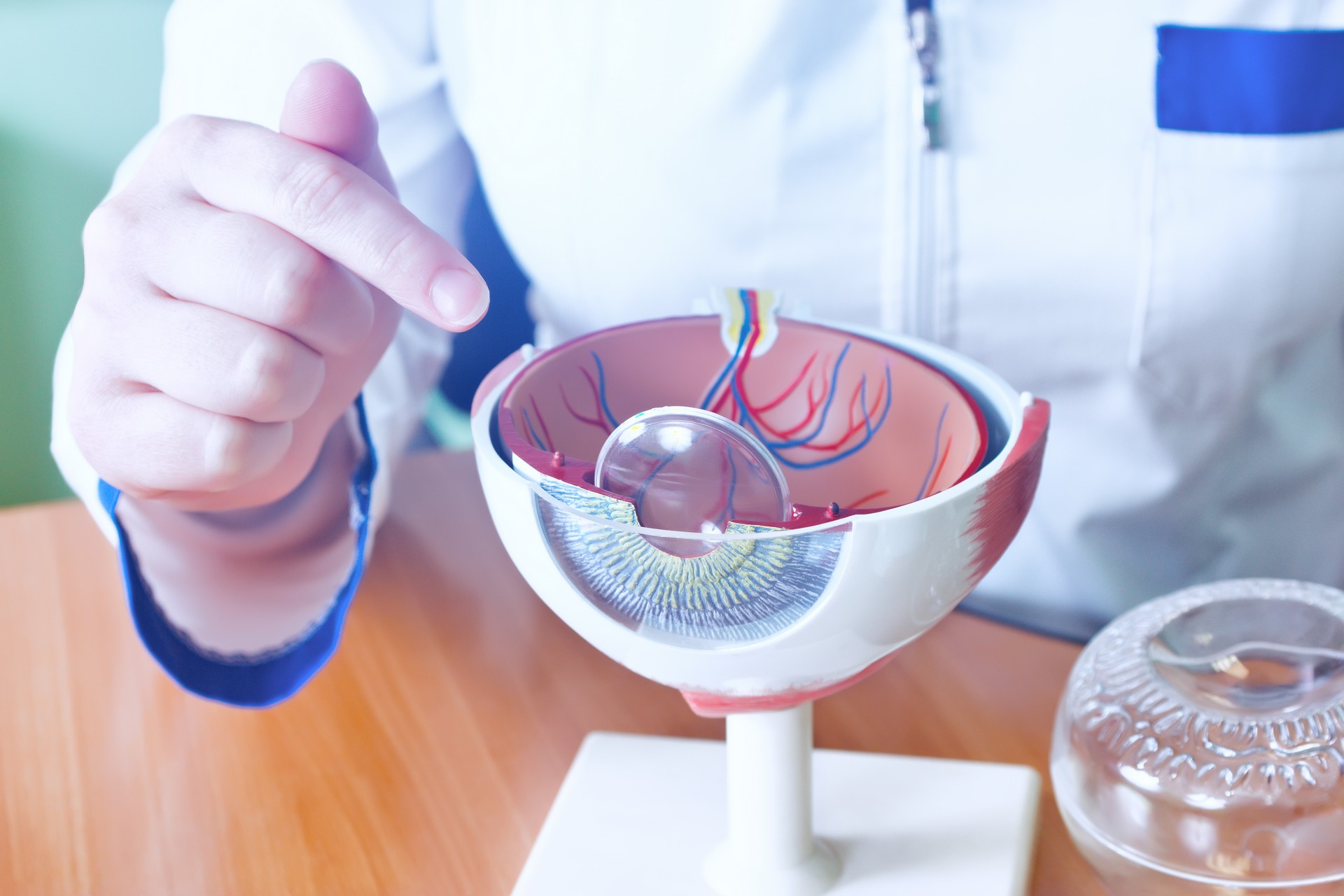
What’s this all about? Your healthy eye is perfectly spherical. The cornea is smooth like the surface of a soccer ball. But in astigmatic people, the cornea has an elliptical shape – it is more elongated, like a rugby ball. This improper shape causes light, instead of focusing perfectly in one place on the retina, to hit it through two points (or more!). The result? A blurred, distorted image!
Where does astigmatism come from? (Congenital and acquired causes)
Doctors won’t point you to one cause with 100% certainty. In many people, it’s a congenital defect that we inherit in our genes. Sometimes it appears later, during puberty, or – worse – it may be the result of some eye injury.
Traditional Correction: Glasses and Lenses – Are They Enough?
Cylindrical lenses and toric contact lenses
We start with what is readily available: special eyeglass lenses that we call cylindrical, or toric contact lenses.
When is traditional correction sufficient? (Regular astigmatism)
When the defect is not very complicated – we’re talking about regular astigmatism – then glasses and lenses do the job. They provide sufficient sharpness to function normally.
When do glasses and lenses fail? (Complicated astigmatism and accompanying defects)
Well, what if astigmatism is very complex? Then traditional methods stop working:
- You have irregular astigmatism – the cornea is so distorted that no lens will correct it perfectly.
- It is accompanied by a large defect (myopia or hyperopia).
- Another eye disease has appeared (for example, cataracts). In such situations, glasses and lenses provide too little. This is the moment when you need to think about something more permanent and precise.
Laser Correction of Astigmatism – Precise and Permanent Solution
Qualification and Scope of Laser Correction
Before we even think about laser, we need to perform precise diagnostics. That’s our foundation! Fortunately, laser vision correction is a powerful tool – we can use it to remove astigmatism reaching even approximately 6 diopters. What’s great? In 99% of cases of this less complicated astigmatism, laser takes care of it once and for all!
Combining LVC with other procedures
Think of it as a premium package: we can simultaneously correct your astigmatism and another defect (myopia or hyperopia) during a single LVC procedure!
And what if you have astigmatism and cataracts? We can implant special toric artificial intraocular lenses. Then we eliminate both problems at once.
Statement by Dr. Victor Derhartunian:
“Astigmatism is no longer a sentence! Thanks to the precision of the femtosecond and excimer laser, we reshape the cornea anew. We literally redraw it to give it that ideal, spherical shape. Patients who struggled with toric lenses for years regain full comfort and visual acuity the very next day. It’s a truly amazing feeling – to see the world without distortions!”
Most commonly used methods of laser correction of astigmatism
At SwissLaser, we use only the best and proven methods:
- LASIK method: This is a classic, very effective. We cut the cornea with a microkeratome, and then the laser reshapes its surface.
- LASEK/PRK methods: Here we gently fold back (LASEK) or remove (PRK) the top layer of the cornea (epithelium) and reshape the tissue underneath using an excimer laser.
- Femto-LASIK method (All-Laser-LASIK): This is our modern technique! We perform the cut with a precise femtosecond laser (hence the name All-Laser-LASIK), which minimizes invasiveness, and then the excimer laser reshapes the exposed cornea.
Procedure Course and Recovery
How does laser vision correction proceed? (Anesthesia and conditions)
The entire procedure is quick and painless. We perform it under local anesthesia (drops!) and in outpatient conditions. It’s not a hospital stay, but a short visit after which you return home.
Discomfort after the procedure vs. discomfort during the procedure
Remember: during the procedure, nothing hurts! If discomfort appears, it’s after the procedure, but it is short-lived and controlled. You need to be prepared for those few days of recovery, but it will pass.
Post-procedure recommendations – key to full recovery
For the effect to be permanent and safe, you must absolutely follow the doctor’s recommendations after the procedure. These include using drops, avoiding exertion and screens in the initial period. You will learn everything at the consultation!
FAQ – Most Frequently Asked Questions about Astigmatism and LVC
Is astigmatism always a congenital defect?
Not always. We often inherit it, but it can also appear later, during puberty, or as a result of some eye injury.
Can astigmatism be cured with traditional glasses?
Cylindrical glasses and toric lenses only correct the defect, but do not cure it. If you want to get rid of this elliptical corneal shape once and for all, you need to opt for laser vision correction.
How many diopters of astigmatism can be corrected with laser?
At SwissLaser Clinic, thanks to the latest technologies, we can remove astigmatism reaching under optimal conditions approximately 6 diopters. Of course, we analyze each case individually.
Are LASIK and PRK methods equally effective in treating astigmatism?
They are equally effective in terms of outcome, but differ in execution technique and how quickly you return to full form. The doctor at the consultation selects the best method (including modern Femto-LASIK) specifically for you, taking into account corneal parameters
Can astigmatism be corrected with laser?
Yes. Regular astigmatism is one of the standard indications for laser vision correction and is corrected in the same procedure as myopia or hyperopia.
Does astigmatism return after laser correction?
The correction effect is permanent because the shape of the cornea is changed. With age, presbyopia may appear, but this is a separate process, unrelated to astigmatism.
What to do when the cornea is too thin for laser?
The alternative is toric phakic ICL lenses, which correct astigmatism without removing corneal tissue and remain fully reversible.
Sources
- Read SA, Collins MJ, Carney LG. A review of astigmatism and its possible genesis. Clin Exp Optom 2007;90(1):5–19. doi:10.1111/j.1444-0938.2007.00112.x
- Chuck RS, Jacobs DS, Lee JK et al. Refractive Errors & Refractive Surgery Preferred Practice Pattern. Ophthalmology 2018;125(1):P1–P104. doi:10.1016/j.ophtha.2017.10.003
- Kim TI, Alió Del Barrio JL, Wilkins M, Cochener B, Ang M. Refractive surgery. Lancet 2019;393(10185):2085–2098. doi:10.1016/S0140-6736(18)33209-4