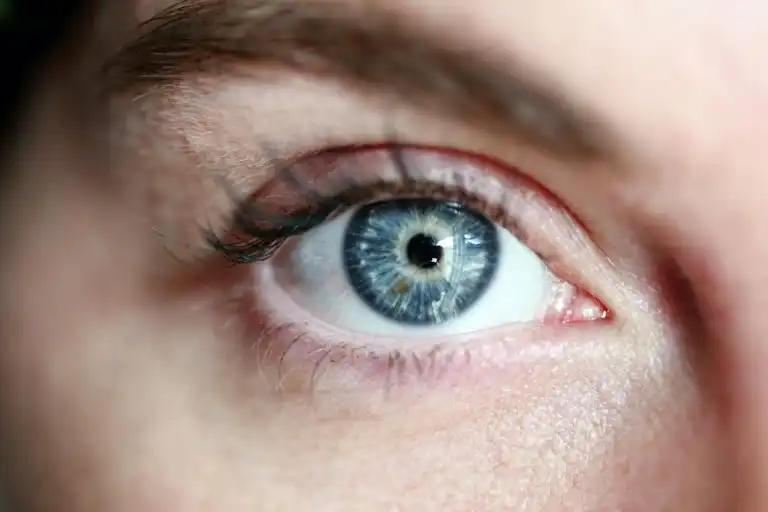
The Macula – In Brief
- The macula (macula lutea) is less than 5 mm of the retina with the highest concentration of cones – it is responsible for sharp central vision, reading, faces, and colors.
- Macular degeneration (AMD) begins with the waving of straight lines and a spot in the center of the image; the periphery remains clear, and complete blindness does not occur.
- The Amsler test at home, and macular OCT in the office – this examination detects changes before you notice them.
- What helps: for the dry form, a diet rich in lutein, AREDS2 formula, and quitting smoking; for the wet form, anti-VEGF injections.
Let’s start with a frank question: what is the absolute center of your vision? Most of us think of the eye like a camera. We know the retina (film), we know the cornea (lens). But we often completely ignore a tiny, yet incredibly important spot on the retina that is responsible for you being able to read these words at all. We are talking about the macula.
For many patients, it’s our internal terra incognita – an unexplored land. It doesn’t worry us until we hear the diagnosis: degeneration (AMD). And suddenly, we realize it’s an attack on the core of our ability to see the world! Does this mean you have to wait until age takes its toll? Absolutely not! That’s why this article was created. We will show you how this wonderful mechanism works and what you can specifically do to consciously protect it.
What will you learn from the text below?
- 1. What exactly is the macula? Imagine it’s a tiny, yellow spot on the retina that acts like an image processor in our eye and is crucial for sharp, colorful vision.
- 2. Why is the fovea so important? It’s where cones are grouped, connected to the brain like fiber optics, providing us with the highest quality and sharpness of vision.
- 3. Does age automatically mean AMD? The risk jumps up after 70, but with a proper diet and supplementation, you can effectively slow down this process.
- 4. What supplements work best for vision? Lutein and Zeaxanthin are the only antioxidants your macula naturally absorbs, which is why these ingredients are invaluable for daily protection.
- 5. Can too many vitamins be harmful? Yes, it can be detrimental! An excess of vitamin A or selenium, especially in smokers, can paradoxically lead to the accumulation of harmful deposits in the retina.
The Macula – Unexplored Land and Optical Center of the Eye
To appreciate this small area, we need a quick reminder of the eye’s structure. The macula lies in the inner part – in the retina.
What is the Macula Lutea? Location and Structure
The macula owes its poetic name – macula lutea – to its natural yellow coloration, which every ophthalmologist sees during a fundus examination. It’s a small part of the retina, but what it does is immense!
The Foveola Centralis – The Heart of Highest Acuity
In the central part of the macula, there is a delicate depression called the foveola. This is truly a masterpiece of nature!
- Densest here: A multitude of visual receptors are gathered here.
- Zero compromises: Interestingly, you will find almost exclusively cones here (there are about 60,000!), while rods (responsible for vision in darkness) have been pushed to the periphery of the retina.
The Key Role of Cones and Rods in the Macula
These cones in the macula are color masters!
- Superpower: Cones give us the ability to distinguish basic colors: red, green, and blue. Thanks to this, our brain can assemble the entire rich palette we see every day.
How Does the Macula Ensure Central Vision and Details?
The macula not only sees colors but also provides us with what we call central vision – that best, sharpest quality.
- No traffic jams: Why is the image so sharp? Because information from each individual receptor goes to the brain via a separate, dedicated fiber optic cable.
- Meanwhile, at the edges: If we look beyond the macula, we will see that several receptors must share one fiber, which naturally lowers the quality and precision of the image. Do you feel the difference?
AMD – Age-related Macular Degeneration – Who is at Risk?
Unfortunately, time passes. The macula, like the entire body, ages over the years. We must be vigilant.
What is AMD (Age-related Macular Degeneration) and When Does It Appear?
Age-related Macular Degeneration (AMD for short) is a disease associated with our age.
- Statistics warn: The problem affects as many as 30% of people over 70 years of age.
- However, it is worth remembering that the first symptoms can be observed as early as fifty! Does this mean you have to worry after 50? No, but you must get examined and take care.
Genetic Factor – Risk of Inheriting AMD
Here, genes play a significant role. If someone in your family has already suffered from AMD, your risk increases 20-fold compared to the general population. This is the moment when prevention should become your number one priority.
Expert Statement – Dr. Victor Derhartunian:
“In my surgical practice, I often encounter AMD, but I always tell patients: we are not defenseless! Knowledge of the mechanisms of drusen formation and damage in the macula allows us to implement such effective supplementation that we can speak of a real slowing down of disease progression. This is our advantage – knowledge of what exactly works at the cellular level.”
Ways to Slow Down Macular Degeneration – Diet and Supplementation
Exactly. Don’t wait for AMD to catch up with you. You have a powerful tool in your hand: food and appropriate supplements.
Antioxidants Essential for Eye Cell Protection
In the fight against eye cell aging, antioxidants are our superheroes:
- Vitamin C (most often 500 mg daily): This is our powerful cleaner that fights free radicals.
- Vitamin E (200–400 mg daily): It protects those delicate polyunsaturated fatty acids (PUFAs) in photoreceptors.
The Role of Vitamin A and Provitamin A (Beta-carotene)
We must dose Vitamin A carefully, because although it is important, it is also insidious:
- Attention smokers! Beta-carotene, or provitamin A, is forbidden for habitual smokers. Always consult your doctor about the dosage.
Risk of Excessive Supplementation (Lipofuscin and Drusen)
Why is this caution so important? Because excessive vitamin A intake can be harmful! It is a building block for lipofuscin, which forms drusen (yellow deposits) in the retina. Drusen are bad – they cause poorer night vision and make lines appear crooked when reading. Remember also that selenium in excess works in reverse of what it should (pro-oxidatively)!
Zinc, Selenium, and DHA Acid – The Secret of Cell Membranes
- Zinc and selenium are other antioxidant allies.
- DHA (docosahexaenoic) acid: This is the champion! Over 50% of the fatty acids in cones and rods are DHA. It actively cleanses the retinal pigment epithelium and protects against damage.
Lutein and Zeaxanthin – Natural Filters in the Macula
These two substances are unique because:
- They are the only antioxidants that nature has placed directly in the macula!
- They form the yellow pigment to which the macula owes its name. They act as natural blue light filters.
Antioxidant Absorption – What You Need to Know About Age?
You must remember one thing: an older person’s body does not absorb ingredients like a sponge. In a 75-year-old with a good stomach, it will absorb:
- Only 20–30% of antioxidants from capsules.
- 50–60% of those you get from food.
This is further proof that the best supplement is simply a well-balanced diet!
FAQ – Frequently Asked Questions about the Macula and AMD
1. Does AMD mean complete blindness?
No. Macular degeneration primarily damages central vision (the center of the visual field). Peripheral vision is usually preserved, so the patient does not lose the ability to move around but loses the ability to read, recognize faces, and see details.
2. Does laser vision correction increase the risk of AMD?
There is no scientific evidence linking laser vision correction (such as FemtoLASIK or ReLEx SMILE) with the development of AMD. AMD is a disease of the retina and macula, while laser correction acts on the cornea (the outer layer of the eye).
3. When should I start taking eye supplements?
If you have a genetic predisposition (AMD in the family) or are over 50 years old, now is the ideal time to discuss this with an ophthalmologist. It’s better to act proactively!
4. Do sunglasses help protect the macula?
Yes, very much so! Remember that exposure to UV radiation and blue light is a risk factor. Good glasses with UV 400 filter and polarization protect the macula from damage and oxidation.
5. Is high myopia (high minus prescription) associated with AMD?
No. High myopia (above -6 diopters) can lead to degenerative changes in the retina, but these are called myopic degeneration, not AMD. Although both affect the retina, they have different underlying causes and mechanisms.
6. What is the macula responsible for?
For sharp central vision, recognizing details and colors: reading, faces, driving. It occupies less than 5 mm of the retina but concentrates the most cones – the rest of the retina provides peripheral vision and spatial orientation.
7. What are the first symptoms of macular degeneration?
Straight lines (door frames, letters in text) begin to bend or wave, a spot or blur appears in the center of the image, letters “disappear,” and colors fade. Symptoms usually start in one eye – a simple Amsler grid test allows them to be detected at home.
8. How does one see with macular degeneration?
The periphery of the image remains clear, but the center is distorted, blurred, or covered by a dark spot. A person with AMD can navigate in space but cannot read or recognize faces directly. Complete blindness does not occur in AMD.
9. What helps the macula?
For the dry form: a diet rich in lutein and zeaxanthin, supplements according to the AREDS2 formula, quitting smoking, and UV protection. For the wet form: anti-VEGF intravitreal injections that inhibit leaky vessels. The condition for effectiveness is early detection with an OCT examination.
Macular examination
The condition of the macula is assessed by OCT — a painless and non-contact examination.
- OCT examination — imaging of retinal layers
- Fundus examination — retinal assessment
- Ophthalmologist in Krakow — 15/U3 Kluczborska Street, qualification examination 400 PLN
- Ophthalmologist in Warsaw — 1 Kolejowa Street, at Zachodni Station
- Diagnostic tests – price list